Why China's Industrial Overcapacity Persists
Weak spending and a production cycle that follows global trends and chases supply chains across the world have lifted China out of its startling poverty. Is the same now slowing down the Asian giant?
In 2023, a worker at CATL's Sichuan subsidiary said that promotion had slowed; “Level two to three used to take six months, but now takes two high-performance ratings, and level three to four takes a year and five high-performance ratings. Forget about it. If you can't move up a grade, you can't earn much,” said Yan Hui (name changed to preserve privacy). With rising inflation, even in 2023, this was difficult to handle for many workers. A sector dependent on state support to sustain itself will continue producing even when it finds few markets for its output; that is easier than adjusting its processes and output, and every adjustment may require engagement with the government and red tape. Organisations and players within such sectors may even have to cartelise in order to be heard and lobby together, something that is almost impossible to do in a state-run economy like China. Kari Heerman at Brookings argues that identifying this requires evidence on subsidies, profitability, investment and capacity use. An export surplus helps make the case domestically to keep it going, but that alone cannot establish it.
Domestic limits
The domestic policy question has been how to raise spending without relying on another expansion of industrial investment. Michael Pettis argues that investment-led growth also holds consumption back. At a time when exports grow at an unsteady rate (2026 has seen a massive jump in AI-related exports from China as an exception to the unsteady growth in preceding years), the state continues to support multiple other critical sectors. The overinvestment has caused households to bear the cost of support for firms and the state. With lower interest on savings and barely any wage growth in the majority of the companies supported by the state, consumption cannot drive domestic liquidity.
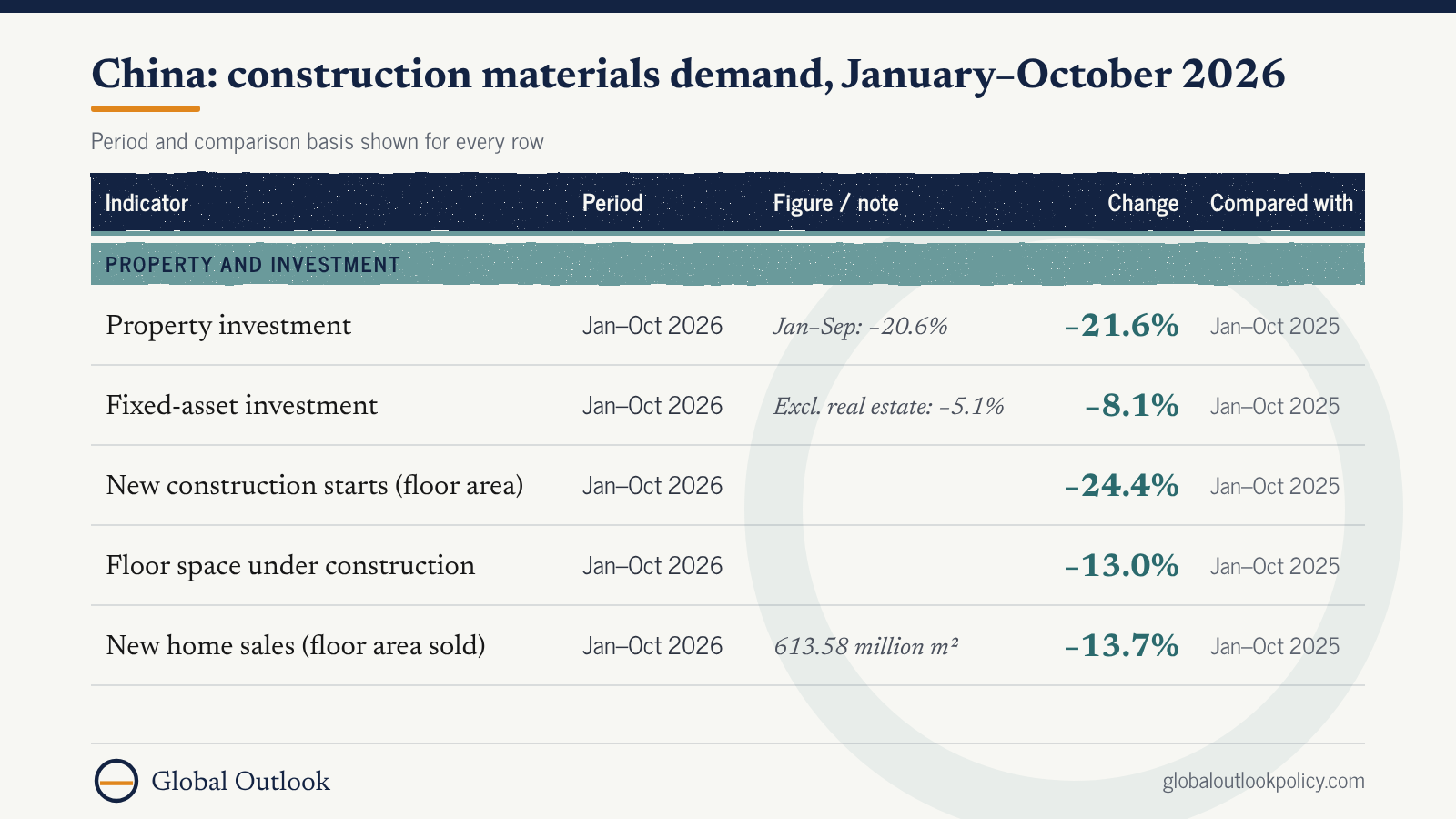
Infrastructure investment, which previously supported demand when other sectors slowed, is also contracting. For January to October 2026, official figures reported by Xinhua show property investment down 21.6%, infrastructure investment down 5.1% and manufacturing investment down 2.9%. Several earlier sources of growth are weakening at the same time, and adjustment at a strategic level is harder to do. It is also telling that new construction starts fell 24.4% in the first ten months of 2026.
The real estate crash, headlined by Evergrande but supported by multiple cascading failures before it, has led to entire ghost-town demolitions and driven multiple families to destitution. Obviously, such factors have not aided confidence in domestic investment by individuals. The property slump has also reduced demand for construction materials in addition to weakening household finances. Cement output has gone down about 29% from 2020. Cement prices have fallen 16.4% by 2025. The usage of steel in the country’s construction sector has also fallen by about 9% since 2020, going from 58% to 49%, with manufacturing picking up some of the slack. Unfortunately, total crude steel demand fell from 1.05 billion tonnes in 2020 to 910 million tonnes in 2025.
The contraction has led the government to try to limit supply in select industries. The state planner's March report proposed orderly capacity reductions in steelmaking and oil refining, and capacity management in copper smelting, alumina and coal chemicals. Reuters noted that it supplied no numerical targets or detailed plans. In October, reporting on the industry ministry's briefing described tighter controls on new alumina and copper-smelting capacity in a bid to limit surplus. The effects of overcapacity extend beyond the building industry to multiple sectors, however, especially those driven by domestic consumption.
Retail sales of light passenger vehicles fell 22% to 13.33 million units in January–September 2026, the twelfth straight monthly decline. October retail sales fell 27%. Exports are picking up the slack, but the numbers vary, and overcapacity is indicated. The Chinese EV market was down 13% year to date at the end of September, with September itself down 18% year on year. In October, China, with 1.14 million sales and more than half the global total, was the only market globally to register a yearly decrease.
Changing export markets and supply chains
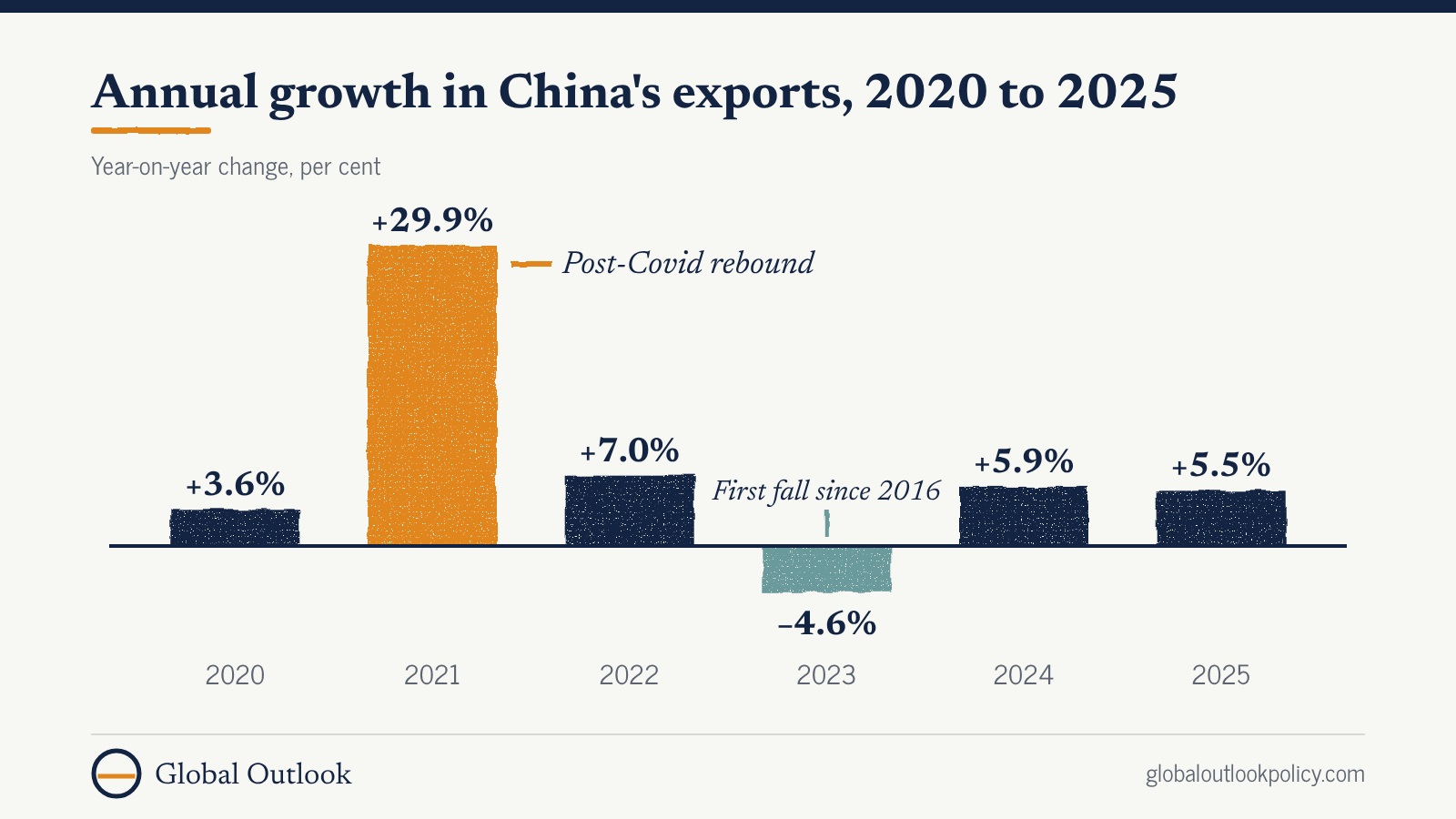
Multiple domestic pressures call for an examination of whether foreign markets can absorb production or whether further policy adjustments are needed. Older export industries face uneven demand. An examination of China's changing exports finds that longstanding exports such as shoes, toys and furniture have declined or stagnated while complex machinery, chemicals and data-centre equipment have expanded. This is consistent with an economy losing momentum in some established activities while gaining in others.
Manufacturing diversification is able to sustain Chinese exports even when final assembly moves elsewhere. Firms seeking to reduce exposure to disruption in China may open another production site while continuing to buy Chinese machines and parts. The destination of China's exports changes, but their contribution to production does not necessarily disappear.
An analysis of trade data reports that India's telephone-equipment exports rose from $1.1 billion in 2017-18 to $33 billion in 2025-26. In the latter year, China supplied 44.2% of India's electronics imports. These imports include components required by Indian assembly operations. India's gains also coincide with a loss of Chinese market share in a strategic category. China's share of US telecommunications-equipment imports fell from its 2018 peak of 65.5% to 21.2% in 2025. India's share reached 17.4%, and Vietnam's reached 21.7%. These figures show a change in direct sourcing by the United States, while illustrating how China remains important in the supply chain even as other nations try to take control of strategic sectors in a geopolitically volatile time. At the same time, without rebalancing the sectoral production capacity, overinvestment to merely maintain statistics and employee morale is an accompanying risk.
The European Commission finds similar patterns in Vietnam, Mexico and Taiwan: they have increased their shares of US imports while sourcing a growing share of their inputs from China. It is telling that Chinese value added in total US imports has remained broadly stable despite declining direct bilateral trade. More exports of parts can therefore coexist with a reduced Chinese share of final production for particular markets, but whether this also causes policy restructuring or whether companies remain beholden to older subsidies and produce beyond what is required will be revealed only over the next few years. This caution is not uninformed, and it should be remembered that this has happened with both real estate and infrastructure in China; thus, an oversight committee to audit and rebalance the numbers may be helpful.
Solar energy
Solar manufacturing shows what loss-making investment looks like when capacity runs well ahead of demand. The International Energy Agency (IEA) reported that more than 90% of major Chinese solar manufacturers recorded net losses, and that more than 70 companies have filed for bankruptcy or liquidation since 2024. Cumulative net losses at major manufacturers and polysilicon producers rose from about $4.4 billion in 2024 to almost $5.5 billion in 2025. Module prices are now 10% to 30% above 2025 levels, which has not been enough to restore profitability. The first half of 2026 also saw the same pattern. Tongwei posted losses of 5.12 billion yuan and Longi lost 3.68 billion yuan. Of 77 listed solar companies tallied by PV-info, 46 were loss-making in the first half.
Exit has been slow. A GCL Technology executive estimates polysilicon capacity at about 3.5 million tonnes, with producers running at 30% to 40% of capacity under industry self-discipline in the fourth quarter. He estimates that about half of the capacity could not keep running if energy-consumption standards were strictly enforced and the lines were not upgraded. Demand is also weak at home. Tongwei chairman Liu Hanyuan said domestic installations fell this year, because spot power prices of 0.1 to 0.2 yuan per kilowatt-hour and curtailment cut the returns of plant developers. The IEA adds that the upstream segments hold most of the excess capacity, and that solar manufacturers outside China have kept median net margins of 10% to 15% since 2023.
Electric vehicles
Chinese carmakers are selling more vehicles while earning less. Caixin reports that the industry's sales profit margin was 4.1% in 2025 and 2.9% in the first two months of 2026. BYD's 2025 revenue rose 3.5% while its net profit fell 19% to 32.6 billion yuan. GAC posted its first full-year loss since 2012, at 8.8 billion yuan.
Capacity use differs sharply between firms, however. At GAC, Aion ran at 54% and Trumpchi at 46%, against a national figure of 73.2%, and GAC's own-brand vehicles lost 8,300 yuan each at the gross level. Bloomberg data show BYD's average discount reached a record 10% in March, with Geely and Chery discounting more as well. In June, the industry ministry and the market regulator summoned automakers over suspected irrational competition and below-cost dumping.
Part of the cost has moved to dealers. Industry inventory reached 3.34 million units at the end of October, about 60 days of supply, and Gasgoo notes that shipping to meet targets moves stock from factory warehouses to dealers while retail sales lag. The share of profitable dealers fell from 39.3% to 23.5% in 2025, and in August, 78.1% of dealers faced price inversion, meaning new cars sold below their purchase price. Overcapacity can be curtailed, but not without significant damage to a sector dependent upon state subsidies. This cycle, in which the state correctly spots trends in global requirements and builds capacity to integrate itself into the supply chain, only to find itself overproducing for a shrinking market, repeats itself every few years in China. The problem is that these cycles seem to be getting shorter. In a volatile international landscape, with more and more protectionism creeping in, China’s own domestic consumption contracting, and overinvestment not being corrected in time, the results can be frustrating for the polity.
Steel
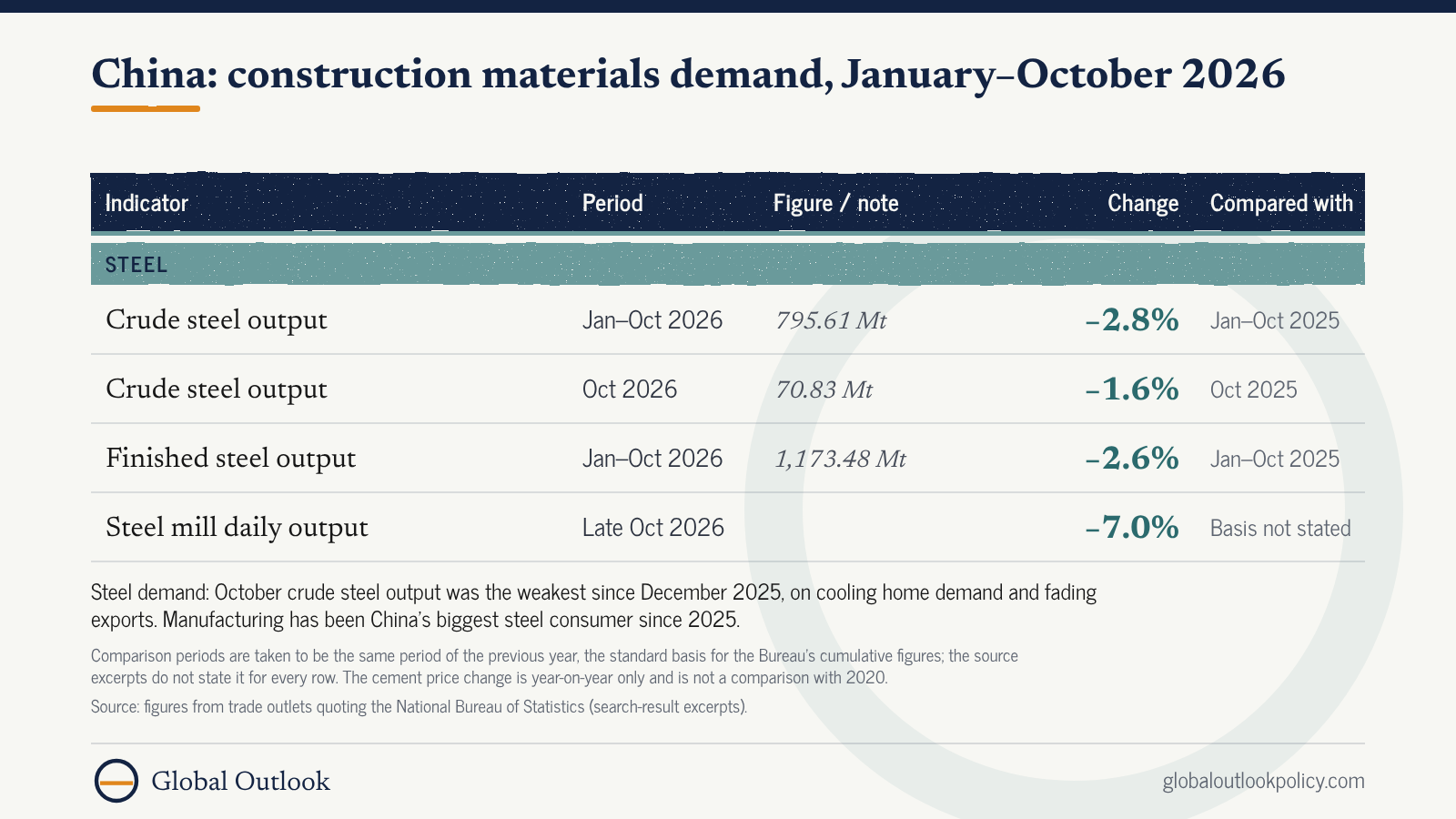
Steel has been one of the most glaring examples of overinvestment in a sector where output has not followed demand down. In the first nine months of 2026, crude steel output fell 2.9% to 725 million tonnes while apparent consumption fell 3.8% to 625 million tonnes, according to the China Iron and Steel Association. Exports of 85.64 million tonnes absorbed much of the difference, but even they fell 2.6%.
Profits show the result. Profits at the association's member mills fell 27.4% to 71.8 billion yuan. Profits from steelmaking alone fell 75.2% to 12.6 billion yuan, and one-third of mills made losses. Steel prices are at a ten-year low for this period, with inventories rising as demand weakened faster than production. In September the China Iron and Steel Association (CISA) urged members to cut output voluntarily to reduce inventories and secure reasonable returns.
Cement
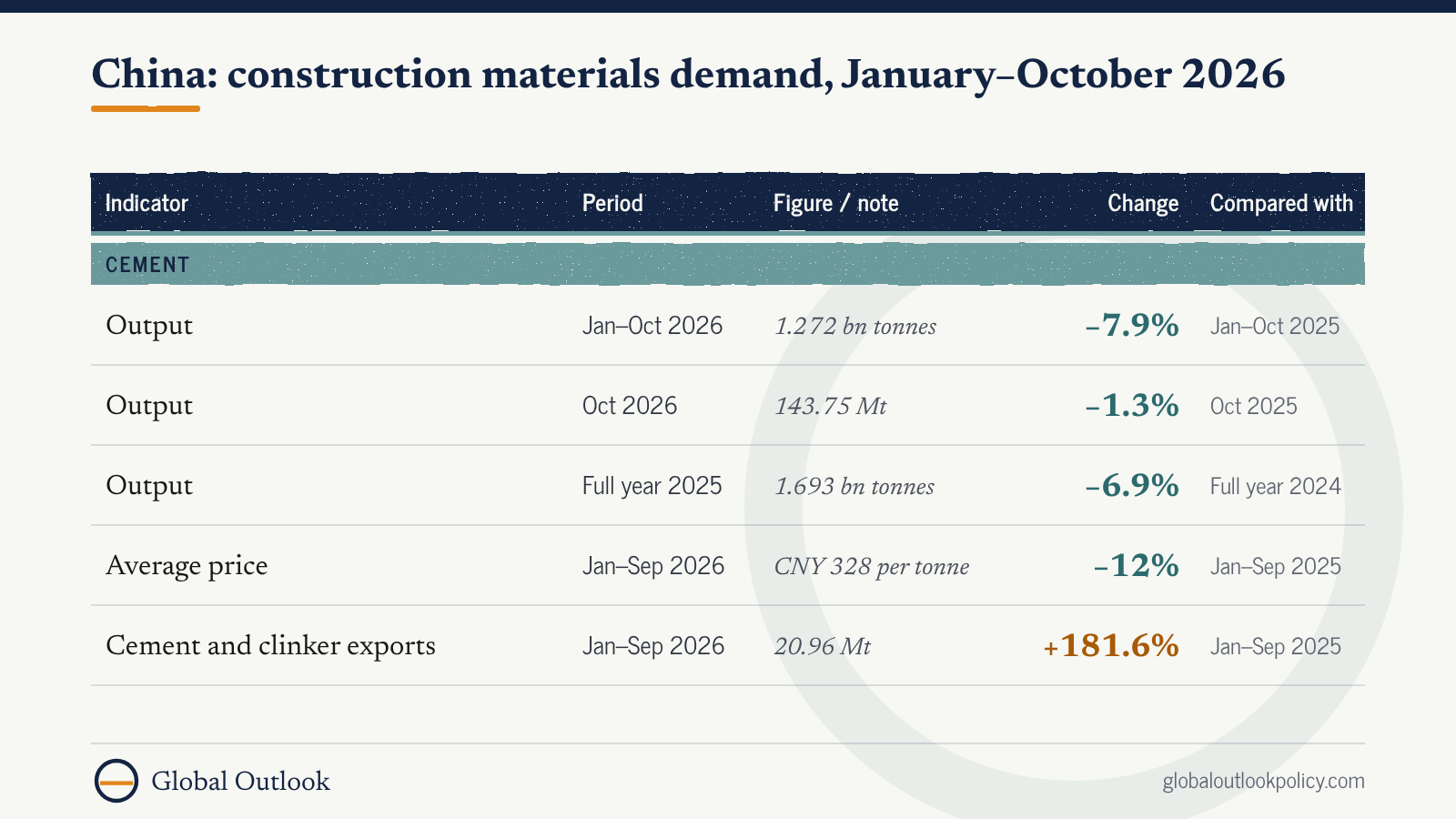
Cement has the sharpest fall in demand, because it depends most on property and infrastructure construction. Output in the first nine months of 2026 was 1.131 billion tonnes, down 8.6% and the lowest for the period in 18 years. Fixed-asset investment fell 7.2% over the same period.
Prices fell along with volumes. The average price was 328 yuan per tonne, down 12% on the year. Rising coal costs added about 30 to 40 yuan per tonne by late in the quarter. The industry lost about 7 billion yuan in only nine months. Among 19 listed cement companies, 12 made losses. The more recent price increases were driven by costs and the low season, not by a recovery in demand and thus do not take away from the losses in the sector.
Exports have been able to absorb some of the surplus. Cement and clinker exports rose by over 100%, though at lower prices. The chief executive of Asia Cement (China) expects domestic output to fall 29% over the next five years, and foreign demand for cement is unsteady. A significant portion of the exports are for Chinese projects abroad, and too many of these have been called out for poor quality of construction, making them unlikely to pass checks in countries with stricter standards.
Overcapacity is a problem
Exports relieve only part of the pressure. Multi-sector falls at a time of undulating international demand are not uncommon, but China’s integration into an exceptionally wide supply chain network enables it to adjust production at different nodes of this chain. The problem remains one of steadying strategy with regard to investment and output, which is far harder to execute on the ground than to discuss in a boardroom or a government office. Combined with corruption and bureaucratic struggles, this puts Chinese producers in the dangerous position of being incapacitated by overcapacity at some stage. The policy response has also stayed partial: the state planner's March report set no numerical targets, and the capacity limits described in the sectors above are mostly voluntary. Three problems remain open. Capacity has no binding route out. Domestic spending has not replaced investment as a source of demand, which helped the neighbouring Asian economy of India when foreign institutional investors pulled out of the market earlier this year. Loss-making firms that remain are still producing at prices that do not cover their costs.
If the numbers on output and exports continue to look healthy while losses spread, what will signal that the adjustment has been postponed again, and who suffers the delays?
If this piece was useful, subscribe for the right take on global affairs and expert opinions. It is free.
Read more on China
Let the Chips Fall Where They May, But Fall They Do: The NVIDIA Inside Track
Did NVIDIA mess with the wrong people? Democrat control of AI no longer a pipedream as Huang becomes fodder for the machine.
24 Sept 2026The Fading Force of American Tariffs on China
Weeks after China tightened rare-earth licensing in 2025, a Ford plant stopped. Xi Jinping arrives in Washington with the same licensing rules still in force.
21 Sept 2026BRICS is a Hedge and a Signal, One That Delivers Real Leverage in a Multipolar Order
As Washington's regional bets falter, BRICS members insist the bloc is “non-West, not anti-West”
More from Trade & Finance
India Has Replaced Import Substitution With Second-Generation Trade Deals
India's first-generation FTAs widened its trade deficits and led to its 2019 RCEP withdrawal. Second-generation deals now target affluent consumer markets, paired with domestic industrial policy.
09 Nov 2026A Quicker Recovery: Why India Is Weathering the Global Market Shocks
With 7% growth, a young workforce and two sovereign upgrades behind it, India's market has held up while the US, China and Brazil lurch.
23 Oct 2026The Hindu Rate of Growth, Reclaimed: India's Case for a New Economic Identity
A Whitepaper on Policy, Growth, and India's Rise in the Global Economic Order, 2014–2026