India Has Replaced Import Substitution With Second-Generation Trade Deals
India's first-generation FTAs widened its trade deficits and led to its 2019 RCEP withdrawal. Second-generation deals now target affluent consumer markets, paired with domestic industrial policy.
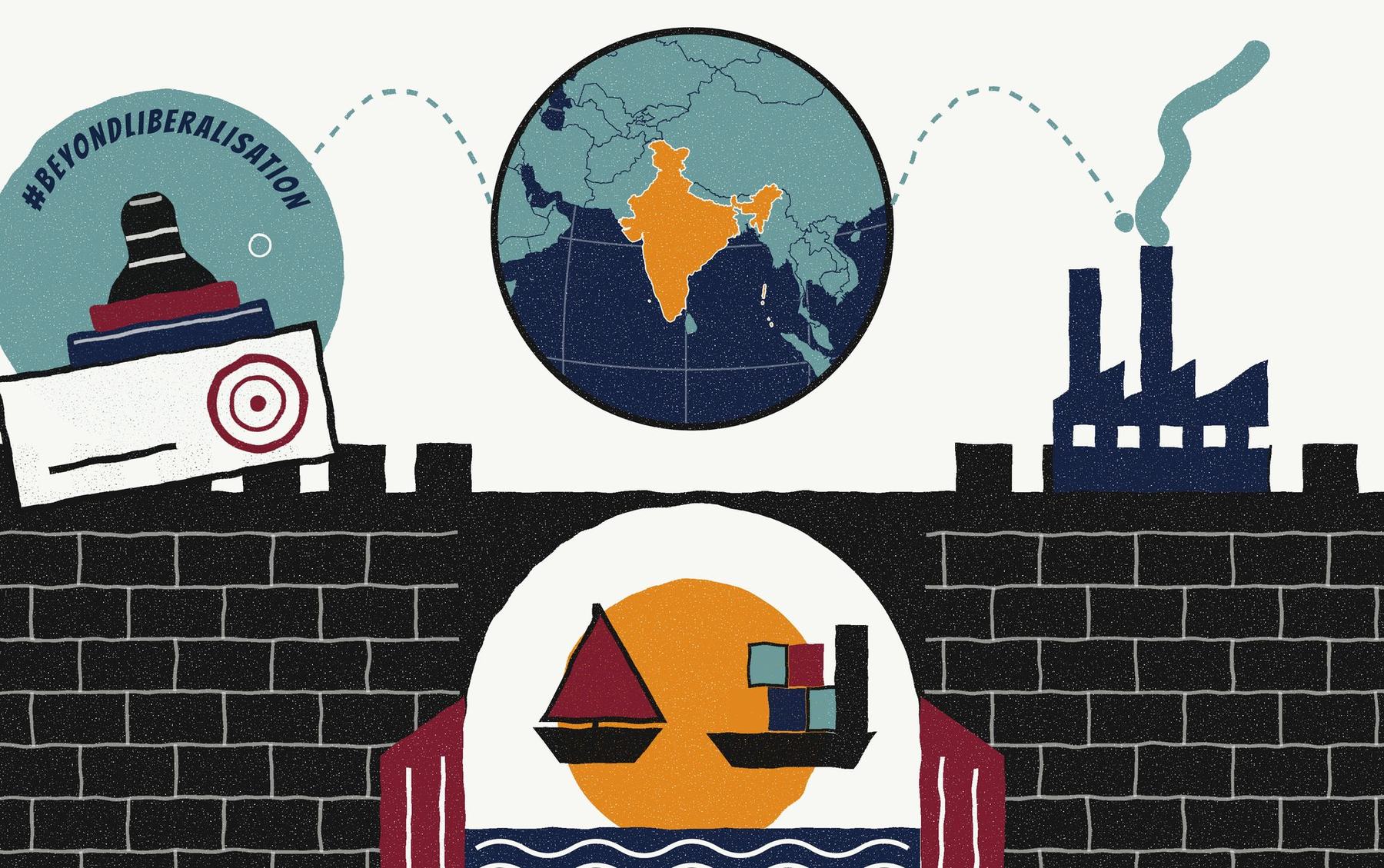
India today is the most open economy in the world. For the economic commentary stereotypes, this assertion may sound hyperbolic. But in an era where every significant economy is receding inwards, busy building small yards and high fences, India has chosen to embrace the world, negotiating and taking to completion a wave of Free Trade Agreements (FTAs) and Bilateral deals.
Despite India being a founding member of both the General Agreement on Tariffs and Trade (GATT) and the World Trade Organization (WTO), India’s inward orientation has been a feature of economic planning and thinking. After decades of this domestic centricity, India is now making bold leaps, looking to trade deals with richer countries, which can be both a market for Indian produced goods as well as sources of sticky, patient foreign direct investment (FDI).
This should have been the default state of thinking post-Independence, but it was not so. When India emerged from colonial rule in 1947, the leadership viewed international trade through the prism of historical trauma. The ink had not even dried on the horrors of the Bengal famine and the violence that followed the partition. India had witnessed a trading company transform into an imperial ruler and then leave humanitarian disasters in its exit path. Policymakers equated economic openness with vulnerability and dependency.
Hence, despite joining the GATT as a founding member, the newly minted nation-state turned decisively inward, adopting an import-substitution industrialization model. India adopted the license – permit raj, high tariff barriers, strict import licensing policies and capital and currency controls to nurture domestic self-reliance. The state-led economic model did kickstart some foundational heavy industries.
However, it severed India from the post-war global manufacturing boom just as countries like Germany, Japan and South Korea were rebuilding. The agrarian crisis and constant dependency on the United States for wheat further stymied views favouring market openness. Export pessimism became entrenched orthodoxy with the belief that the world would anyway not buy Indian goods, so India need not try to sell them.
But this was not always the case. For millennia, the Indian subcontinent was the beating heart of global commerce. Indian Ocean – the “ocean of churn” – was the global expressway to trade-led prosperity. Long before the modern vocabulary of supply chains and tariff schedules were coined, Indian merchants navigated monsoon winds to link the Roman Empire with Southeast Asia, exporting textiles, spices and gemstones in exchange for vast inflows of gold and silver.
For Indians, trade was always a civilizations instinct – exploring now shores, inscribing signatures of Indian culture and heritage – all supported by sophisticated guild networks, maritime technology and coastal ports that welcomed traders from all over the world. Yet, the trajectory of independent India’s economic journey hugely diverged after this welcoming attitude led to a period of thousand years of colonization. A striking paradox emerged: a nation forged in commercial cosmopolitanism spent decades retreating behind walls of protectionism, hesitantly dismantling them mostly out of compulsions of macroeconomic crisis and stumbling through asymmetric trade agreements.
Within multilateral forums like the WTO, India positioned itself as a vocal champion of developing-world solidarity. India fought fiercely – often for principles like the special and differential treatment and almost never for its own commercial interests. Membership in global trade forums were largely perceived to be the instrument of rules-based protection against arbitrary discrimination. Being part of the global trading architecture did not translate into becoming a global export powerhouse. India’s share of world merchandise exports steadily dwindled from over two percent at independence to less than half a percent by the 1980s.
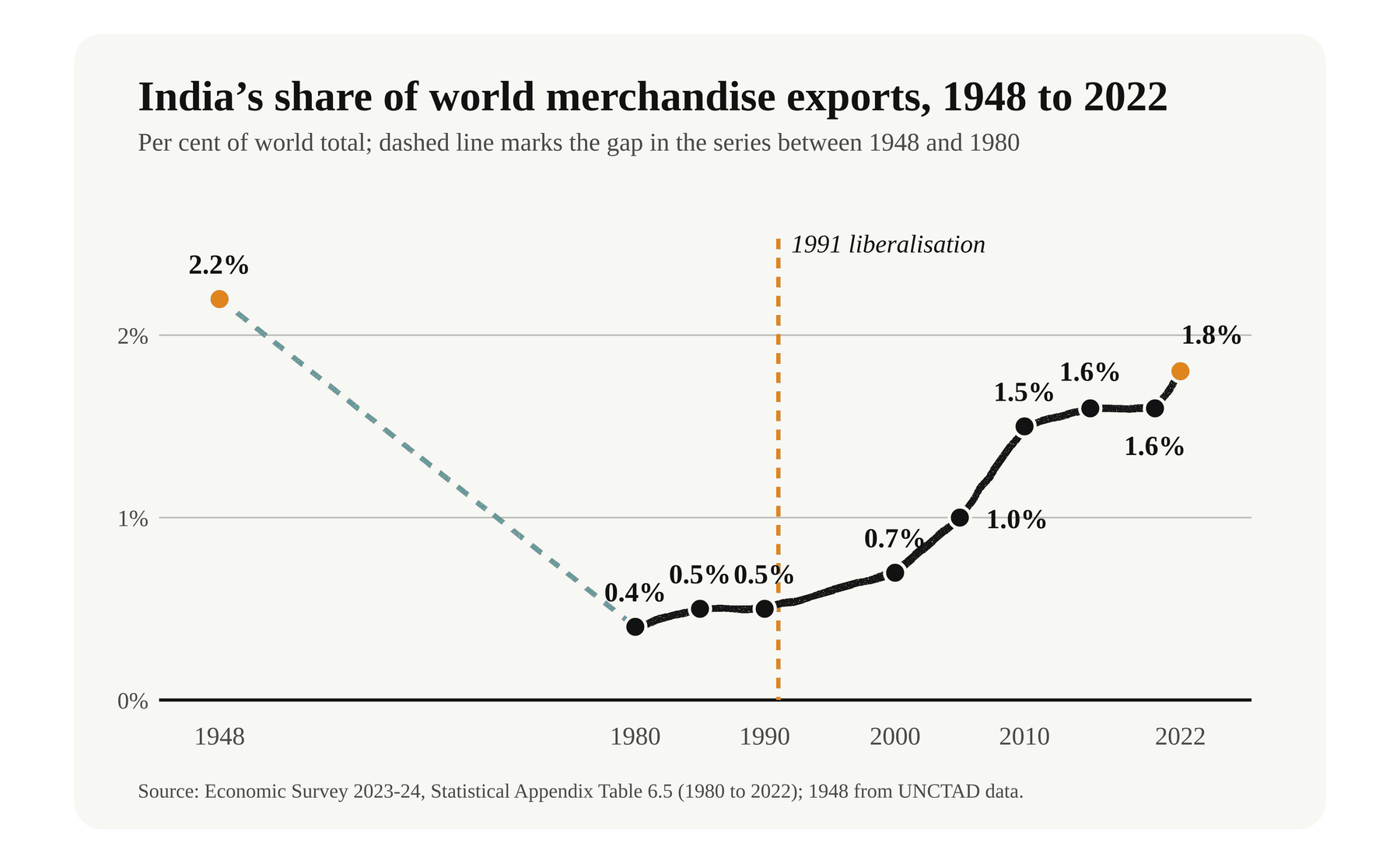
Even the watershed economic liberalization of 1991, triggered by a severe balance-of-payments crisis, failed to fully cultivate a deep-rooted culture of trade. The “Bombay Club” continued to hold its sway over policymaking. India dismantled the license, permit quota raj and even slashed peak tariffs. And while this unleashed domestic entrepreneurship in business services and sparked a revolution in information technology, merchandise trade remained an afterthought for much of Indian industry.
Protected for generations, domestic conglomerates found it far more lucrative and comfortable to cater to a vast, growing home market than to battle cutthroat competition abroad. Rigid labour laws, high logistics costs, and infrastructural bottlenecks further blunted export competitiveness. Liberalization opened India’s doors to global capital and consumer goods, yet it stopped short of turning the country into an export-oriented manufacturing engine.
With stalled multilateral negotiations at the WTO a few years after it was created, India pivoted to the first generation regional and bilateral FTAs. India signed comprehensive pacts with ASEAN, South Korea, Japan and Malaysia in quick succession. These economies were established manufacturing destinations and India’s negotiating positions did not fully bake in commercial strategies.
The outcome was sobering. Because Indian manufacturing lacked scale and cost efficiency, domestic firms struggled to utilize the preferential access granted by partner countries. Conversely, foreign competitors leveraged lower tariffs to flood the Indian market with electronics, machinery and intermediate goods. India’s trade deficits with its FTA partners ballooned, breeding deep scepticism within government and industry alike. Trade agreements came to be viewed as traps that hollowed out domestic manufacturing.
That experience also eventually led to India’s dramatic last-minute withdrawal from the Regional Comprehensive Economic Partnership (RCEP) in 2019. This decision of course was a pragmatic one, as RCEP would effectively have an agreement with China and had the potential to sound the death knell of Indian manufacturing.
However, that inflection point forced a fundamental rethink. Rather than retreating into isolation, policymakers recognized that India could not become a major global economy by standing outside major trading blocs. It could also not succeed by signing weak agreements without domestic industrial reform.
Over the past few years, India has embarked on a new chapter – slew of enabling domestic reforms and crafting "second-generation" FTAs with large, complementary, developed economies such as the Mauritius, United Arab Emirates, Australia, the European Free Trade Association (EFTA), the United Kingdom, Oman, New Zealand and pursuing ambitious negotiations with and the European Union.
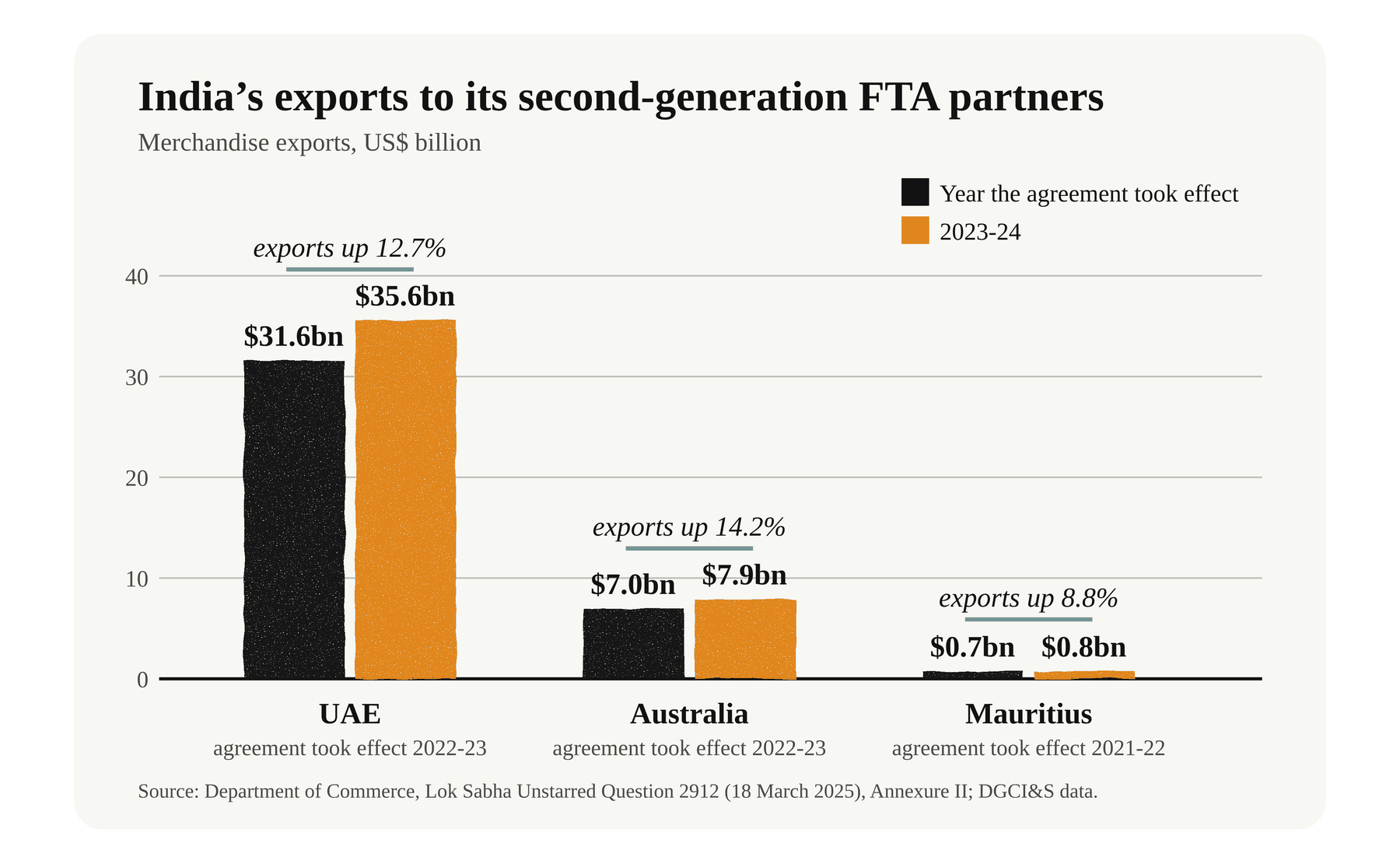
Unlike earlier pacts with competing Asian manufacturing hubs, these modern agreements target affluent consumer markets where Indian labour-intensive sectors such as textiles, pharmaceuticals, gems, engineering goods and digital services enjoy natural advantages, while securing critical technology, capital and raw materials in return. Crucially, this external push is now paired with domestic industrial policy aimed at building scale, upgrading infrastructure and integrating into global value chains as multinational corporations diversify away from single-country supply dependencies.
India’s trade policy evolution reads like a century-long pendulum swing – from ancient maritime openness to post-colonial insularity, through reluctant liberalization and bruising bilateral experiments, toward a confident, strategic re-engagement. The lessons of past missteps have tempered idealism with pragmatism. Today, India is no longer treating trade agreements as diplomatic gestures or defensive concessions, but as calculated instruments of economic statecraft – seeking, at last, to reclaim its historic place at the crossroads of global commerce.
Aashish Chandorkar is an entrepreneur, author and consultant focused on Geoeconomics and International Trade. He also works in public policy and has served as Counsellor for the Permanent Mission of India to the World Trade Organization.
The views expressed in this piece are the author's own. Global Outlook publishes contributed opinion as a platform and does not necessarily endorse it.
If this piece was useful, subscribe for the right take on global affairs and expert opinions. It is free.
Read more on India
Whispered Prophecies of a Return: Is Hasina Coming Back to Bangladesh?
Fresh violence in Narail after Gopalganj as minority Hindu homes burnt and Awami League support cited. Residents fight back.
18 Nov 2026The End of the Cartel Century: OPEC, Russian Crude, US Shale and India's Refining Pivot
A Research White Paper on the Geopolitics of the Global Oil Transition
08 Nov 2026A diya in every embassy: How India uses Diwali to bring home to its diaspora
From the first indentured ship to reach Mauritius to a floating holiday at the UN, Diwali has travelled with India's diaspora. Today, India's missions abroad are helping turn it into a bridge between that diaspora, the countries it lives in, and home
More from Trade & Finance
Why China's Industrial Overcapacity Persists
Weak spending and a production cycle that follows global trends and chases supply chains across the world have lifted China out of its startling poverty. Is the same now slowing down the Asian giant?
09 Nov 2026A Quicker Recovery: Why India Is Weathering the Global Market Shocks
With 7% growth, a young workforce and two sovereign upgrades behind it, India's market has held up while the US, China and Brazil lurch.
23 Oct 2026The Hindu Rate of Growth, Reclaimed: India's Case for a New Economic Identity
A Whitepaper on Policy, Growth, and India's Rise in the Global Economic Order, 2014–2026