BRICS is a Hedge and a Signal, One That Delivers Real Leverage in a Multipolar Order
As Washington's regional bets falter, BRICS members insist the bloc is “non-West, not anti-West”
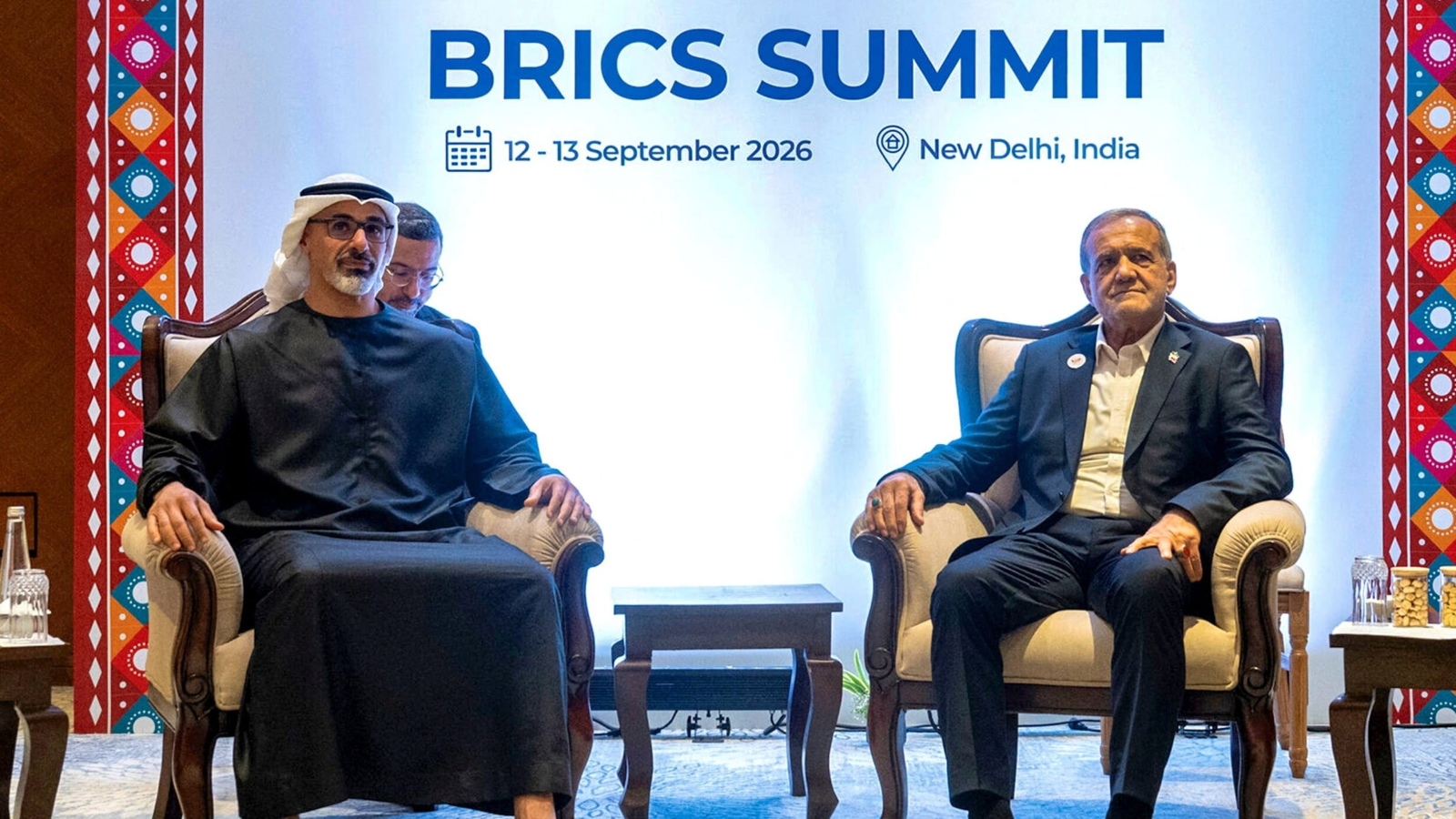
Iran struck the United Arab Emirates directly during the war that began on 28th February 2026, hitting Dubai International Airport, the Al Dhafra air base used by American forces, and oil infrastructure at Ruwais and Fujairah. The UAE recorded at least 13 dead and 224 wounded from 31 nationalities, and by April had intercepted more than 400 ballistic missiles and 2,000 drones with its Patriot and THAAD batteries. The Emiratis retaliated with strikes of their own on Iran's Lavan Island, shut their embassy in Tehran, revoked Iranian residency permits and called Iran's attacks a “flagrant violation” of international law. Six months later, in New Delhi, Masoud Pezeshkian sat across from Sheikh Khaled bin Mohamed bin Zayed Al Nahyan, who led the UAE delegation on behalf of President Mohamed bin Zayed, for their first known face-to-face meeting since.
Pezeshkian's visit was Iran's first presidential trip to India in eight years, made while his country remains at war. It was also his second meeting with the Indian Prime Minister in under two weeks, after the two held talks at the Shanghai Cooperation Organisation summit in Bishkek in August.
India’s participation in BRICS had been read for much of the past year as a hedge built while New Delhi hoped for warmer terms from Washington. While the UN loses significance, multilateral platforms such as the SCO and BRICS have started to regain prominence in certain regions, at least in terms of optics and signal. Every grouping is not a standard alliance, and neither are they comparable to NATO. However, the fact that BRICS was able to bring together leaders of two warring nations in West Asia, at least temporarily, showcases remaining potential that cannot be written off with dismissiveness.
Indian officials, the hosts, drafted the joint declaration's language on the behalf of Iran and the UAE. The dispute was over how to describe regional attacks: the UAE wanted Iran named directly, while Iran wanted the declaration to name the United States and Israel instead. Indian diplomats wrote alternative wording that named neither, modelled on a 2025 Shanghai Cooperation Organisation statement issued in Bishkek that had avoided naming countries in a similar dispute. The resulting BRICS declaration ran to 45 pages, reportedly the longest the bloc has issued, and Iran and the UAE separately signed a joint statement calling for restraint in West Asia. Kabir Taneja, a fellow at the Observer Research Foundation, said of the Pezeshkian meeting: “This meeting does not mean that it is a rapprochement between the UAE and Iran. But of course, India would have played a small role to give that space in this multilateral system.” Flights between Tehran and Dubai and Iranian use of UAE airspace had already resumed before the summit.
Xi Jinping arrived in Delhi for his first visit to India in seven years. He told the gathering that the West Asian war “does not serve the common interests of the international community,” and set out a four-point proposal built on peaceful coexistence, respect for national sovereignty, international rule of law and coordination between development and security. The proposal stopped short of offering to host talks between Iran and its adversaries. Xi also confirmed China will take the BRICS chair next year and host the 19th summit. In his bilateral meeting with Modi, Xi described the relationship in what Xinhua reported as “strategic, long-term” terms, and spoke of mutual benefit from each country learning from the other's strengths, even as the two countries' border dispute remains unresolved. In 2023, China had brokered peace talks between Saudi Arabia and Iran, after seven years of silence between the Shia and Sunni states. All of that peace mattered little when the Sunni kingdom drew Iran’s ire in the current war.
Washington's alternative wager in the region has been Pakistan. Pakistan's army chief, Asim Munir, deployed roughly 8,000 troops, a fighter squadron and air-defence systems to Saudi Arabia during the earlier phase of the Iran war and ran an overnight diplomatic push involving Trump, Vice President J.D. Vance and envoy Steve Witkoff. Trump was reportedly on the phone with Munir minutes before announcing the April ceasefire. That ceasefire was violated almost weekly. The commercial side of the relationship has fared no better: a $500 million US-Pakistan rare earths agreement produced a single shipment in October 2025, its flagship Reko Diq project slipped to a 2028 start date, and the Pakistani government approved 257 million rupees in security funding for the site against a request for 1.8 billion.
US ally Saudi Arabia’s own bet on Pakistan has seen an almost comical collapse. The Mecca Pact, a supposedly Joint Defence Agreement signed last month between Turkey, Pakistan and KSA, saw no action by either Turkey or Pakistan when Saudi Arabia was faced with Houthi bombing. On 8th September, Houthi forces fired dozens of ballistic missiles and drones into southern Saudi Arabia, wounding 73 people and setting fire to the Jazan refinery, a 400,000-barrel-a-day facility, along with Aramco installations in Najran and Abha. The Houthis' military spokesman, Brig. Gen. Yahya Saree, claimed the strikes outright. Pakistan offered condemnation from afar.
BRICS may be more signal than substance; however, it offers a stage capable of amplifying both. Vladimir Putin told the gathering the group was ‘not against anyone,’ a line that echoed India's own position at the summit; Indian MP Sujeet Kumar told reporters BRICS was ‘non-West, but it is not anti-West,’ rejecting characterisations of the bloc as anti-American. Pezeshkian, for his part, used his summit remarks to push a narrower and more achievable goal: “One of the most important steps is to expand the use of national currencies in trade among the members,” he said, a target that sidesteps ceasefires and sanctions architecture entirely and focuses on the financial intricaccies BRICS can signal influence over. An alternate BRICS currency and economic architecture is likely to remain in the rhetorical realm as India and other BRICS nations have consistently denied interest on that front. At the same time, the New Delhi Declaration at the summit saw the nations collectively pushback against unilateral American tariffs and sanctions and while internal trade friction between BRICS nations exist to prevent dumping, bilateral trade in local currency may continue to increase.
BRICS may be a hedge. In fact, it was designed as one against a web of platforms and systems and economic policies viewed as being western and exclusive. Certainly, it was seen as a means for China to push its own influence, but multilateralism demands that most nations think along those lines as poles rise and ebb in power. What it, along with other multilateral groupings such as the SCO does show is that there remain options to both, UN insignificance as well as US unilateralism, especially with the inclusion of western pariahs such as Putin and Pezeshkian on these stages.
More from International Affairs
The Gandhian Logic of Peace: India Builds a Larger Playground at BRICS
From Gandhi's internationalism to non-alignment and now multi-alignment, India's 2026 BRICS chairship shows how a large country keeps its freedom of choice.
01 Oct 2026Beyond the State: How Municipal Networks Are Reshaping the Global South
Direct, city-to-city cooperation across the Global South has emerged as an effective operational strategy to tackle overlapping crises, from urban security to climate vulnerability.
17 Sept 2026Macron Chooses Populism as France Sanctions Israel
Qatari money, British angst and rising antisemitism have been a recipe for France’s latest Israel policy