The Fading Force of American Tariffs on China
Weeks after China tightened rare-earth licensing in 2025, a Ford plant stopped. Xi Jinping arrives in Washington with the same licensing rules still in force.
"We have had to shut down factories. It's hand-to-mouth right now," Jim Farley, Ford's chief executive, had said weeks after China began requiring licences for exports of seven rare earths. In late May 2025, a shortage of magnets stopped production of the Ford Explorer at the company's Chicago plant. By early July Washington had lifted its curbs on chip-design software and ethane sales to China and restored General Electric's licences to ship jet engines to the Chinese aircraft maker COMAC, in return for a resumption of rare-earth shipments.
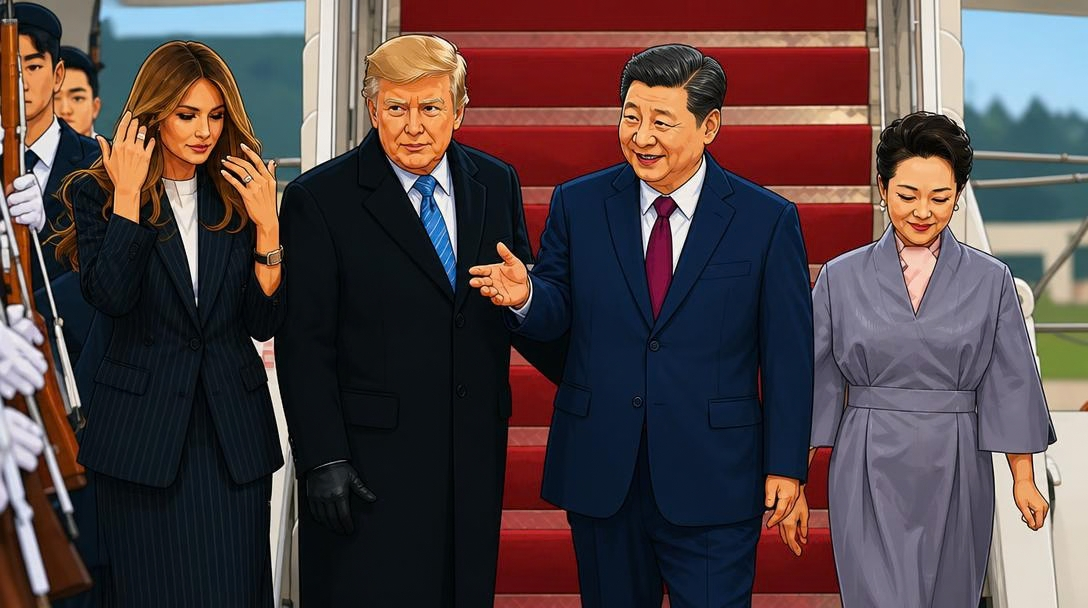
Xi is shortly expected to meet Trump in DC. He was received by Trump receiving him below his airplane in a break from protocol and signalling warmth that is unlikely to be substantiated in the talks. Beijing's current leverage works through export licences that take effect in weeks; Washington's works through tariffs and technology controls that take months to bite and which China has learned to work around. When the two leaders met in Busan late last year, they agreed to a one-year truce. Trump halved a tariff on Chinese goods, from 20% to 10%. Xi paused the sweeping new limits on rare-earth exports that Beijing had announced, but kept the April 2025 licensing rule behind the Ford shutdown. On 20th February, the US Supreme Court struck down Trump's tariffs, along with the others he had imposed under emergency powers. China's pause, however, lasts only "until November 10, 2026, pending further bilateral negotiation." Yesterday, though, on the eve of the latest talks, negotiators extended the truce by two months, to 10th January 2027.
China's leverage comes from its control of rare-earth processing; it controls the stages between the mine and the finished magnet. The International Energy Agency estimates that China accounted for 91% of global rare-earth refining and 94% of sintered magnet production in 2024. Every shipment needs a licence from China's Commerce Ministry. Somewhat exasperated officials in the Trump administration have previously stated that China has fulfilled only two-thirds of its rare-earth commitments. They wonder whether Beijing's throttling of supplies is "a glitch in the system" or "an intentional haircut." Henry Farrell and Abraham Newman, writing in 2019, called this kind of power the "chokepoint effect"-- control of a hub in a global network lets a state "weaponise interdependence."
China's share of global rare-earth processing, 2024 — Share of world output at two stages between the mine and the finished magnet — Rare-earth refining: 91%; Sintered magnet production: 94% — Source: International Energy Agency.
Washington's instruments have not grown stronger in the same period. In addition to the tariff strikedown by the American judiciary, export controls on advanced chips that were meant to be the stronger American lever have proven a dud. China has simply refused American chips even as Washington permits their sale. The Trump administration approved sales of Nvidia's H200 processor to China in December 2025, and by mid-May not a single one had been delivered because Chinese regulators blocked purchases. Mark MacCarty of Brookings in writing about it concluded that "China's regulatory authorities no longer think U.S. chip companies are reliable business partners," leaving American firms with "exactly zero market share of the AI chip market in China."
Trump had been a somewhat different man in his earlier term, less unpredictable, and using a platform of patriotism and non-intervention, and a President without a billion dollar Qatari jet. His methods, however, were not very different. His love for shorter term “wheeling-and-dealing” scenarios had him hound southeast Asian allies for increased protection money while trying to bully China via tariffs. In July 2018 Beijing answered Trump's first tariffs with a 25% duty on American soybeans, and US soybean sales to China fell from $12.2 billion in 2017 to $3.1 billion in 2018, a devastating 75% fall. In 2025, China stopped buying altogether after May, and by mid-October it had booked no purchases of the new American crop, the first such gap in two decades. Brazil was happy to fill the gap both times and supplied 74% of China's soybean imports last year. Washington has had to pay American farmers $40 billion in trade aid across the two trade wars, in packages of $12 billion in 2018, $16 billion in 2019 and $12 billion in December 2025, in lieu of their loss of profit. Wu Xinbo of Fudan University, a government adviser, compared China's position since Trump’s first term: "China is far more confident than nine years ago and what's even more important is that today China has found an effective way to keep the US in check”. The two leaders last met on American soil at Mar-a-Lago in April 2017.
US soybean sales to China — US$ billion, before and after China's 25% duty of July 2018 — 2017: $12.2bn; 2018: $3.1bn — Sales fell 75% in one year. In 2025 China bought no US soybeans after May.
US trade aid paid to American farmers — US$ billion, by package, across two trade wars — 2018: $12bn; 2019: $16bn; Dec 2025: $12bn — Total: $40 billion.
Kurt Tong, a former US consul general in Hong Kong, states that "in the economic space, there isn't really any superior player," and that both governments are "pulling back from actions that cost them to execute." While its foreign leverage is executed with confidence, China's economy is weaker while its domestic problems may be compounding. Youth unemployment reached a recent high in August and the property crisis continues. Wendy Chang of the Mercator Institute for China Studies says its largest AI developers "still need Nvidia chips to keep pace," because Huawei's chips cannot yet meet their demand. COMAC's C919 airliner flies on engines from CFM International, a joint venture of GE and France's Safran. Washington halted their export to China last year.
Jamieson Greer, the US Trade Representative, thinks that three to six months was "probably the right kind of range," so that Washington could check Chinese compliance before committing further, after the rare earth debacle deteriorated trust further. Beijing wanted the truce to run until the end of Trump's term in January 2029. "Just saying we have full confidence in each other ... I think is a little naive," Greer has said. Scott Bessent, the Treasury Secretary, announced the two-month term on Fox News after 90 minutes of talks with Vice-Premier He Lifeng at the World Bank. "We met today to see if we could do a bigger deal as opposed to just a series of smaller things," he said.
The purchases China can offer in return are small against the disruption it can cause. After his visit to Beijing in May, Trump had said China had agreed to buy 200 Boeing jets, a commitment Beijing has not officially confirmed. If the point was to appeal to his domestic audience, it is unlikely to hold much water today. China is willing to meet its 25-million-ton soybean pledge but lags on a separate $17 billion commitment for other farm goods. The two governments have set up a "Board of Trade" to cut tariffs on about $30 billion of goods in each direction. Bessent said the leaders could announce that list, along with measures on financial services and farm purchases, at their meeting. Global Trade Alert calculates $30 billion at 0.14% of American consumer spending. During Trump's first-term trip to China in November 2017, China Energy Investment Corporation pledged $83.7 billion for shale gas and chemical projects in West Virginia, and none of that money materialised.
More from Trade & Finance
India's Labour Data Has No Category for Gig Workers
Gig workers are now covered by the Code on Social Security, yet the PLFS, e-Shram and Census 2027 do not identify platform work. Four changes would fix that.
13 Sept 2026An Optimistic Look at India's Credit Upgrade and its Limited Signal
Japan's rating agency lifted India to A- on steady growth, even as AI-driven job losses, militarised borders and urban protests test citizen sentiments.