Let the Chips Fall Where They May, But Fall They Do: The NVIDIA Inside Track
Did NVIDIA mess with the wrong people? Democrat control of AI no longer a pipedream as Huang becomes fodder for the machine.
Part One: The World's Economy Is Leaning on One Company's Chips
The five largest companies in the S&P 500 now account for roughly 30% of its total market capitalisation, the highest concentration in the index in half a century. Interestingly, albeit unsurprisingly, the S&P 500's overall valuation is comparable to its peak during the dot-com bubble in 2000. Of those five, there is not a single one where NVIDIA has not supplied the processors that train and run the large language models. All five companies’ valuations - NVIDIA, Apple, Microsoft, Alphabet and Amazon - assume that AI will generate returns far beyond what it has managed to prove thus far. NVIDIA's market capitalisation stood above $5 trillion as recently as late October 2026 based on that belief-based valuation.
OpenAI chief executive Sam Altman told reporters in August 2025 that artificial intelligence investment was in a bubble, and in the same set of remarks he called AI "the most important thing to happen in a very long time." Certainly, a technology can be underpriced in its long-run importance while being overpriced in its current valuation. This was also the claim made about data being the new oil in the last decade, a phrase that drove big data models and data science products. However, the scale has increased manifold since then. The AI industry needs to generate roughly $2 trillion in annual revenue by 2030 to justify the capital already committed to building it. The projected actual revenue by that year is $800 billion, a shortfall of a staggering $1.2 trillion.
At least one senior government official has reached for a historical comparison to describe the stakes. US Energy Secretary Chris Wright, who also oversees the US nuclear weapons complex, described the global AI race in February 2025 as "Manhattan Project Two," framing American success in artificial intelligence as a matter of winning what he called the "AI arms race." Wright runs the Department of Energy, which oversees the National Nuclear Security Administration and the US nuclear weapons stockpile, making his choice of name for a commercial technology race a statement from inside the nuclear establishment.
What may differentiate this boom from the two that preceded it - the dot-com crash of 2000 and the crypto and NFT collapse of 2022 - is that the underlying businesses are actually turning a profit and have offered customers, both individual and organisational ones, actual value. Only 19% of large technology stocks were unprofitable going into this cycle against 36% at the dot-com peak, and balance sheets across the sector carry near-zero net debt, a sharp contrast with the leveraged dot-com era. OpenAI's revenue reached an annualised $20 billion in 2025, up from $6 billion the year before in booked revenue rather than a projection. Crypto tokens and NFTs never produced a comparable, auditable revenue line tied to a real service being used at scale while large language models are generating real paid usage today. The scale and scope that have been promised are the problem.
Combined 2026 capital spending plans from Microsoft, Google, Amazon and Meta on AI infrastructure have been estimated at anywhere between $600 billion and $830 billion depending on which items analysts count. NVIDIA's largest customers are also its financial backers in the biggest deals on record, with cloud providers committing to purchase volumes of compute from vendors in which they or their partners hold a financial stake, a structure that inflates reported revenue on both sides of the transaction without proving final demand from end users exists at the scale being built for.
It is also a geopolitical jumble. Taiwan's TSMC manufactures NVIDIA's most advanced chips. In 2025, chips of 7 nanometres and finer made up 74% of TSMC's total wafer revenue. Largely due to NVIDIA dependency, TSMC alone carried about half the weight of the Taiwanese stock index which hit a record near 50,000 last month. A halt at that single facility, from conflict in the Taiwan Strait or any other cause, would stop NVIDIA's production entirely.
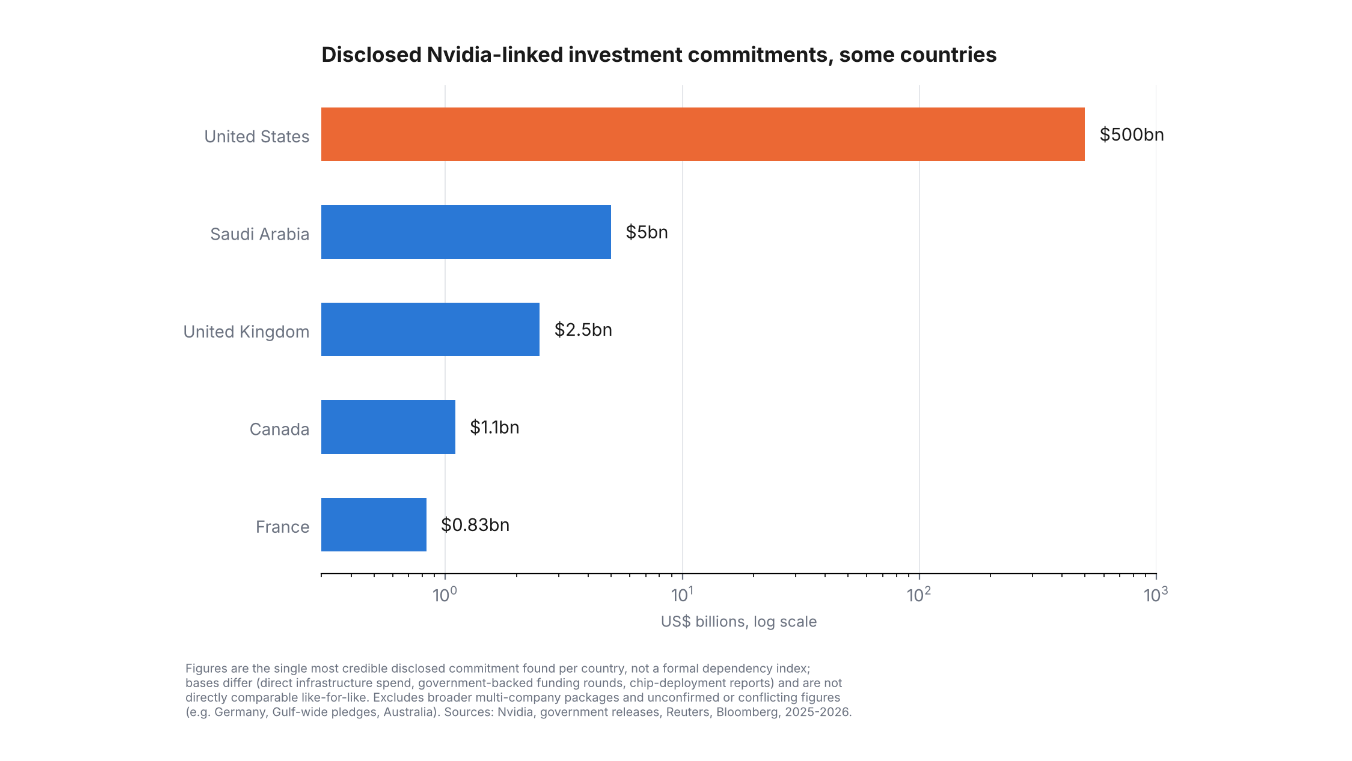
This is why the governments that can are securing their own supply before any disruption at the facility can cut them off. The United States approved the export of NVIDIA AI chips to the UAE and Saudi Arabia in November last year. Gulf states have reportedly pledged around $2 trillion in AI-related investment as the US and China compete for their business. South Korea's SK Hynix overtook Samsung as the world's largest seller of memory chips in 2025, a shift attributed mainly to its supply of the memory NVIDIA's processors need.
China has gone in the opposite direction, not all of its own accord, cutting its dependency. NVIDIA's share of China's AI chip market fell from roughly 95% to roughly 55% after the April 2025 export curbs, as Chinese buyers shifted toward Huawei's domestic chips. Chinese officials now directly allocate access to the NVIDIA chips still available, prioritising domestic alternatives where they can. NVIDIA's China sales had largely stalled by June 2026, even after Trump lifted part of the export ban in 2025.
Japan's SoftBank, Sony and Honda are part of a 44-company coalition building the country's AI infrastructure on NVIDIA chips, after SoftBank sold its entire $5.8 billion NVIDIA shareholding in 2025 to fund the shift from equity to infrastructure. NVIDIA and Reliance Jio are building roughly 2,000 megawatts of AI data-centre capacity in India, alongside a separate NVIDIA cloud partnership with Tata. Germany expanded its AI partnership with NVIDIA at an October 2026 investment summit, a deal reported at figures ranging up to $10 billion. Canada's federal government joined NVIDIA in backing the Canadian AI company Cohere in a funding round valuing it above $20 billion, with Ottawa's commitment reported at up to C$1.6 billion. The United Kingdom committed £2 billion to its domestic AI startup ecosystem through NVIDIA. France's Mistral AI raised $830 million in debt to build a Paris data centre running on NVIDIA chips. Singapore has no comparable investment of its own; it is instead the reported transshipment point under investigation since March 2025 for NVIDIA AI chips diverted toward buyers the export curbs were designed to block.
The world is overdependent on NVIDIA with no recourse in the shorter term. NVIDIA chief executive Jensen Huang's acknowledgment of a personal affair proved its dangers in a single trading session. NVIDIA's shares fell 4.27% on 9th November 2026, cutting roughly $190 billion from the company's market value in one day and pulling its total capitalisation down to $4.31 trillion from above $5 trillion in late October, as that reporting broke. Donald Trump stated that the FBI was "looking into" the matter, and NVIDIA shareholders had already filed suit by the following day.
The Manhattan Project produced a single, discrete capability: a working weapon that either existed or did not, tested once at Trinity in July 1945 and then used twice weeks later. The AI investment Wright compared to it has instead produced a sequence of incremental product releases, chatbots, coding assistants and recommendation systems that improve by measurable percentage points on benchmark tests each year rather than a single breakthrough moment comparable to Trinity.
Part Two: The Question of Timing
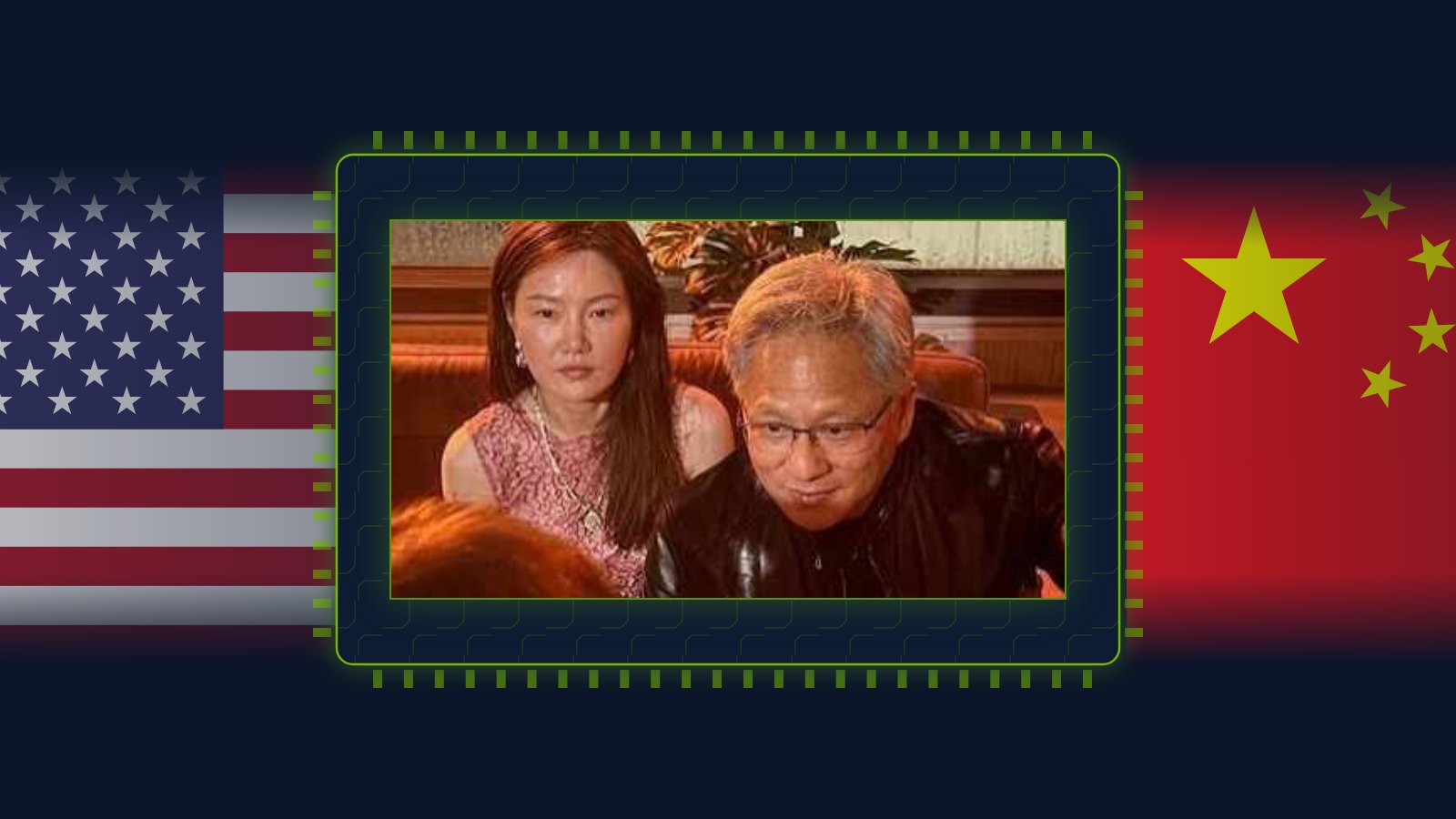
Jensen Huang acknowledged to NVIDIA's board on 8th November 2026 that he had been intimate with Alice Huang, an executive at the Singapore-based chip reseller Megaspeed, telling staff in an internal memo that he had "fallen short" and owed his family and colleagues an apology. NVIDIA's board announced an independent investigation the same day.
US authorities had been investigating Megaspeed and Alice Huang since 2024, after large volumes of NVIDIA AI chips were shipped into Malaysia in a pattern investigators found concerning. Megaspeed's scrutiny by US officials, and an executive at the firm having socialised with Jensen Huang, had already surfaced in reporting by October 2025. NVIDIA's public position at that point was that Huang's ties to the company under investigation were normal; the company separately told reporters it does not share classified information with its customers.
Culper Research, a New York short-selling firm, published a 40-page report titled "NVIDIA (NVDA): The China Problem" on 13th May 2026, disclosing a short position against NVIDIA and flagging what it described as an uncomfortably close relationship between Jensen Huang and Alice Huang, roughly six months before that relationship became a public story. The personal relationship was the smallest claim in the report. Culper alleged that more than 20% of NVIDIA's fiscal 2026 compute revenue remained China-linked through intermediaries, despite NVIDIA's public position that its China revenue had fallen to zero after the April 2025 export curbs. Megaspeed's balance sheet, the report found, grew from $33 million in liabilities in fiscal 2023 to $3 billion in fiscal 2024, built on $2.9 billion in unexplained "refundable deposits received" and mirrored by an identical sum sent onward to its Malaysian subsidiary, Speedmatrix, which Culper says pledged its entire business as collateral in June 2024 to a Singapore entity whose parent is named in filings as Alibaba Group. Speedmatrix imported $4.6 billion of product between December 2024 and January 2026, $4 billion of it from a single supplier still one-third owned by a Chinese state parent company. A source told Culper that a data-centre operator dropped Megaspeed as a tenant in April 2026 after finding it had installed what the source called "dummy servers" to divert hardware, language that echoes a March 2026 Justice Department indictment in a separate chip-smuggling case built on the same staged, non-working equipment.
Secretary of State Marco Rubio drafted a memo around the same point in spring 2026, circulated to officials holding high-level security clearances, alleging that Alice Huang had been recruited by China's Ministry of State Security specifically to target Jensen Huang. That memo was circulated ahead of a Trump trip to Beijing in mid-May 2026, a trip Huang was initially left off before being added back: Air Force One made a refuelling stop in Anchorage, Alaska, and Huang flew in to join the delegation there after Trump called him directly. The New York Times reported on 29th October 2026 that Trump had been briefed on the underlying intelligence roughly a year earlier. NVIDIA's position, given to the New York Times, was that its cloud customers receive "ordinary business information, not sensitive NVIDIA trade secrets, and zero information relevant to national security."
NVIDIA's board statement on 8th November was shared once Huang brought the matter to the board himself. The board's investigation is being run by a committee of independent directors with outside counsel, understood to be led by lead independent director Stephen Neal of Cooley LLP, the firm that has served as NVIDIA's outside counsel since the company's incorporation in 1993. The NVIDIA board has said it has "no reason to believe" national security or company secrets were compromised, without setting a date for its findings.
Three House Republican committee chairs, Brian Mast of the Foreign Affairs Committee, John Moolenaar of the Select Committee on China and Rick Crawford of the Intelligence Committee, wrote to Huang on 4th November demanding a closed-door briefing on 18th November, the day after NVIDIA's quarterly earnings call, and gave him until 11th November to respond. Their letter asked Congress to determine "the extent to which US national security has been placed at risk," the same question the board had already answered for itself four days earlier.
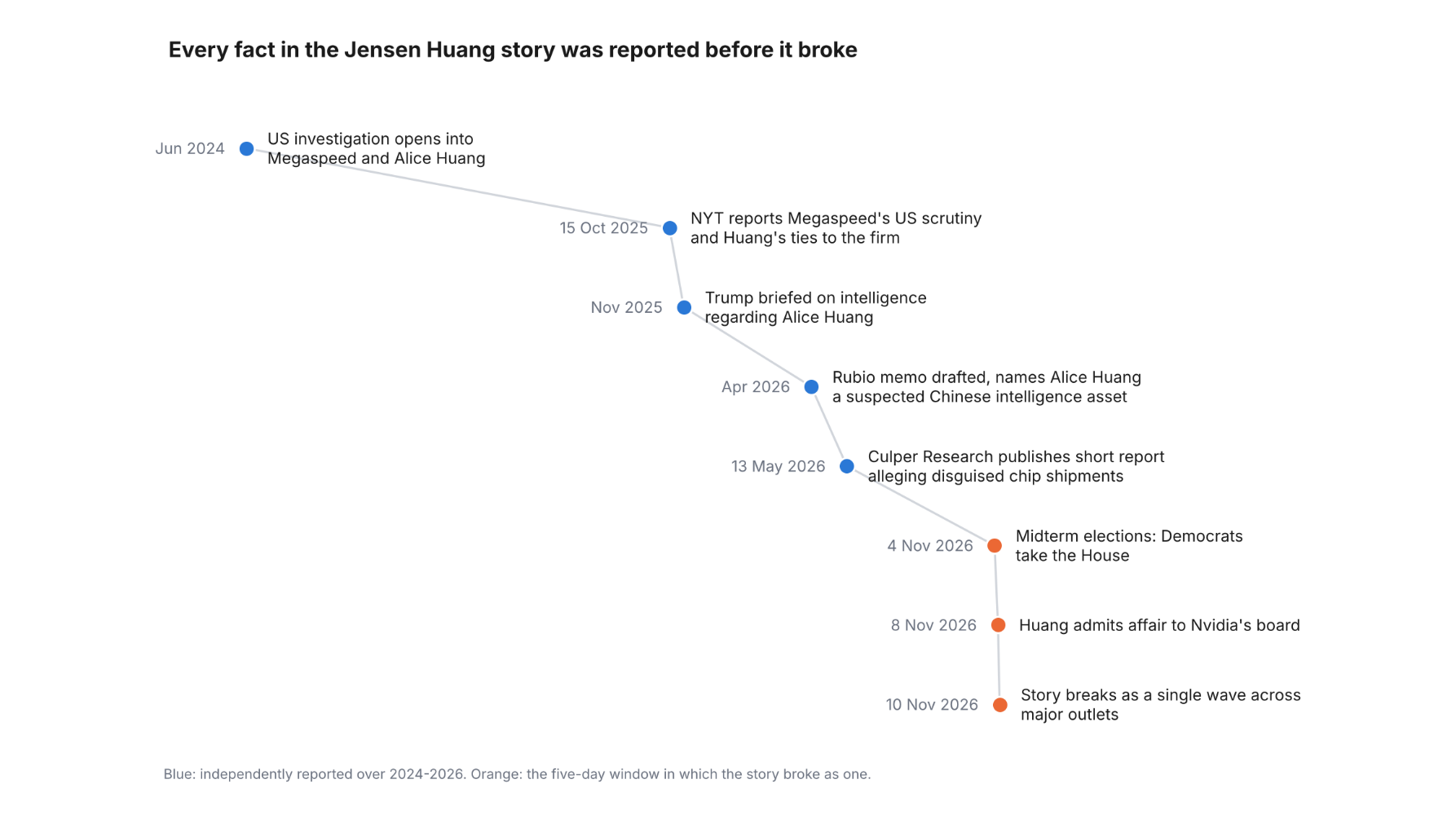
Every one of those facts was independently reported before the story broke as a single wave between 6th and 10th November 2026, in pieces from the New York Times, TechCrunch, the Financial Times and others, between two and six days after the 3rd-4th November 2026 midterm elections, in which Democrats made significant congressional gains. The only variable that changed in that window was control of Congress. The facts had all been publicly reported, in some cases for two years, without producing a single one of these headlines until after Republicans lost the House, with no crowd of comedians cashing in on a scandal as has happened all over TikTok and Meta, or a spurt in historical analysis of honeytrapping as a means of espionage.
The financial incentive behind that timing is rather explicit. Culper Research disclosed a short position against NVIDIA, meaning the firm profits directly from NVIDIA's stock falling on such news. A falling NVIDIA valuation also serves Democrats directly: the party has just taken the House committee seats needed to open hearings and push new regulation on the US AI industry, and the Huang story handed them a live national-security justification for doing so at the precise moment they gained the power to act on it.
NVIDIA remains the centre of the world's AI buildout. Governments that pledged billions of dollars for guaranteed access to its chips, companies that built their valuations on its processors and a stock market that leans on five firms for 30% of its total value all have more invested in NVIDIA continuing to function than in Huang's personal conduct. The scandal cut $190 billion from NVIDIA's market value in a single trading session but has not touched its order backlog, its manufacturing relationship with TSMC, or the governments still racing to secure its chips. It is not unlikely that Huang, with his own insights into US affairs, moves on from the story relatively unscathed, or that Alice Huang’s role as a mole may be overstated.
If this piece was useful, subscribe for the right take on global affairs and expert opinions. It is free.
Read more on China
A Quicker Recovery: Why India Is Weathering the Global Market Shocks
With 7% growth, a young workforce and two sovereign upgrades behind it, India's market has held up while the US, China and Brazil lurch.
24 Sept 2026The Fading Force of American Tariffs on China
Weeks after China tightened rare-earth licensing in 2025, a Ford plant stopped. Xi Jinping arrives in Washington with the same licensing rules still in force.
21 Sept 2026BRICS is a Hedge and a Signal, One That Delivers Real Leverage in a Multipolar Order
As Washington's regional bets falter, BRICS members insist the bloc is “non-West, not anti-West”