Macron Chooses Populism as France Sanctions Israel
Qatari money, British angst and rising antisemitism have been a recipe for France’s latest Israel policy
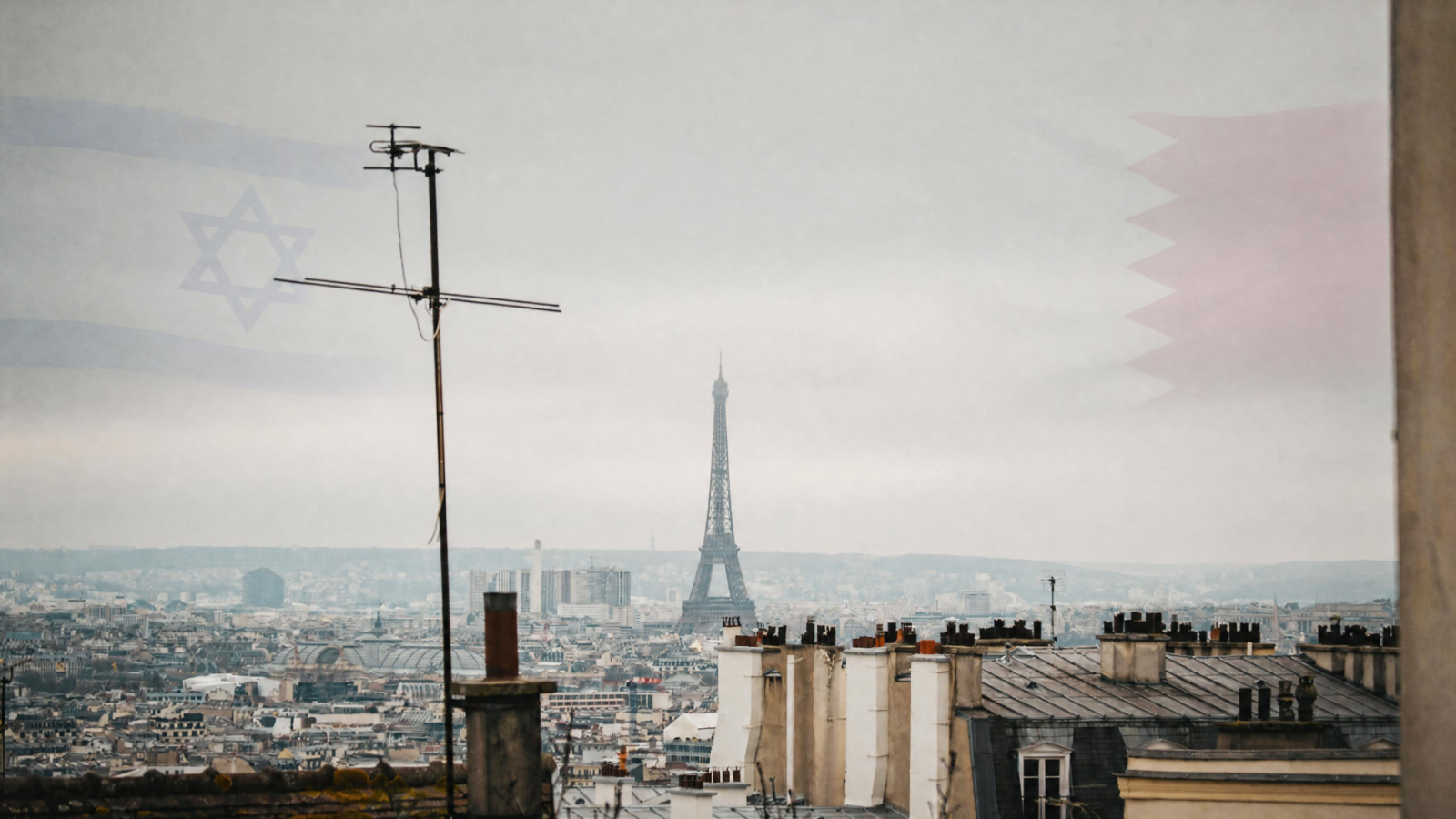
On 8th September, the United Kingdom, under their latest Prime Minister in a long list of short-term leaders, led eleven other western states in sanctioning individuals and entities tied to Israeli settlement construction and restricting trade in settlement goods. The move followed Israel's decision to advance tenders for approximately 1,200 housing units in the E1 area of the West Bank, a project that would sever East Jerusalem from the rest of the territory. Israel's government responded within days by closing the British consulate in East Jerusalem, expelling British officers from a Gaza-related task force and ending a British military training mission in the West Bank. France was one of the twelve governments imposing the sanctions along with Andy Burnham’s UK government, having already recognised a Palestinian state in September 2025, and Israel's response was to treat it as a principal target of its anger, alongside the UK.
In June 2025, French organisers of the Paris Air Show at Le Bourget had ordered black partition walls erected around stands run by Israeli firms including Israel Aerospace Industries, Rafael and Elbit Systems, blocking access to displays of what France classified as offensive weapons. Rafael threatened legal action, and Israeli President Isaac Herzog called the closures "outrageous," comparing them to "creating an Israeli ghetto." Israel's defence ministry called the decision "outrageous and unprecedented," and by March 2026 Israel had halted all new procurement from French suppliers, redirecting it instead toward Israeli industry and countries seen as friendly without caveat.
France's defence ministry had previously stated defensively that two thirds of French exports to Israel consisting of ammunition components are re-exported inside equipment built for third countries rather than used directly by Israel's own forces, a distinction that has not stopped campaigners from citing the trade as proof of distance between France's public position and its industrial one. Israeli orders for French arms had reached €27.1 million in 2024, the highest since 2017, while French export licences authorised for Israel more than doubled that year, from €176.2 million to €387.8 million, covering ammunition components, fire-control and surveillance systems and imaging equipment. A complete rerouting would hurt France, although arms exports since 2025 no longer call out country-specific numbers for Israel. Israel is also diversifying its development bases, shifting to joint manufacturing to India, with IWI and India's Adani Group on small arms, Elbit and Adani producing Hermes 900 drones in Hyderabad, and Israel Aerospace Industries partnering with India's HAL on Heron drones and Barak 8 air defence systems.
French arms export licences for Israel, 2023 to 2024 — Value of export licences authorised, and orders actually placed — Licences authorised: €176.2m,€387.8m; Orders placed, highest since 2017: ,€27.1m — French export licence and order figures. Licences cover ammunition components, fire-control and surveillance systems and imaging equipment. France's defence ministry says two thirds of these exports are re-exported inside equipment built for third countries. Export reports since 2025 no longer publish country-specific figures for Israel.
France’s strategic exposure to Israel is less explained by trade than through capabilities that have become difficult to replicate quickly: intelligence sharing and cyber expertise, battlefield digitisation, electro-optical and sensing systems, drones and counter-drone technologies, missile defence and other specialist defence components. Additionally, France's Harfang surveillance drones (modified Israeli IAI Herons) entered French air force service in 2008 and were used in Afghanistan, Libya and Mali, and French special forces use the Israeli-made Elbit Skylark 1 and 1-LE tactical drones. This dependency was significant enough that France, Germany and Italy agreed in May 2015 to a joint "Euro-drone" programme specifically to reduce reliance on Israeli and US unmanned systems. Separately, France and Israel held direct talks over the NSO Group Pegasus spyware crisis in 2021, after French officials' phones were reportedly targeted.
Interestingly, Qatar has steadily increased their financial footprint inside France since 2011, with stakes in Paris Saint-Germain, the Printemps department store group and the Royal Monceau hotel, and a 1% holding in LVMH bought in 2013 and a significant €10 billion pledge over six years announced in February 2024. Analysts writing for the Jerusalem Institute for Strategy and Security write that this footprint gives Qatar leverage over French policy on Gaza, pointing to Macron's shift from declaring "unreserved solidarity" with Israel immediately after 7th October 2023 to calling for a ceasefire within three weeks.
French net favourability toward Israel fell to negative 48 points in 2026, according to YouGov's EuroTrack survey, among the lowest figures recorded since the tracker began in 2016; only 13% to 21% of respondents across the six European countries surveyed held a favourable view of Israel, and roughly only a quarter of French respondents judged Israel's Gaza campaign justified. The National Rally, whose founder Jean-Marie Le Pen once compared Gaza to a concentration camp, reversed course under Marine Le Pen and now positions itself as one of Israel's firmest defenders in French politics. Party leader Jordan Bardella has said recognising Palestine would mean "recognising terrorism." In the meantime, Macron’s centre-Left Renaissance has shifted in keeping with populist sentiment to echo the left-wing New Popular Front on Israel in these two years.
France's Service for the Protection of the Jewish Community recorded 1,570 antisemitic acts in 2024, barely down from 1,676 in 2023, at a monthly average of 130, a plateau the organisation sees as unprecedented. According to interior ministry figures, Jews were the target of 65% of all religion-based attacks recorded in France in 2024, despite making up under 1% of the population. The surge began within weeks of the 7th October attacks and have not meaningfully receded three years later, even as the government moved from recognising Palestine to sanctioning Israel over the same period.
French Jews moving to Israel, 2023 and 2025 — Number of arrivals recorded each year — 2023: 1,109; 2025: 3,300 — Israel's immigration ministry figures for the two reported years; 2025 arrivals were up 45% on 2024. Over the same period France recorded 1,676 antisemitic acts in 2023 and 1,570 in 2024, and Jews were the target of 65% of all religion-based attacks in France in 2024.
Roughly 3,300 French Jews moved to Israel in 2025 in light of rising antisemitism, public sentiment and governmental policy shift, up 45% on 2024 and nearly triple France's 2023 total of 1,109. Israel's immigration ministry also attributes this to the same antisemitism that accompanies the diplomatic rupture. While this is seen as temporary by many, it is also a signifier of shifting alliances and the quick turn of politics in the backdrop of multiple wars crossing wires.
More from International Affairs
The Gandhian Logic of Peace: India Builds a Larger Playground at BRICS
From Gandhi's internationalism to non-alignment and now multi-alignment, India's 2026 BRICS chairship shows how a large country keeps its freedom of choice.
01 Oct 2026Beyond the State: How Municipal Networks Are Reshaping the Global South
Direct, city-to-city cooperation across the Global South has emerged as an effective operational strategy to tackle overlapping crises, from urban security to climate vulnerability.
21 Sept 2026BRICS is a Hedge and a Signal, One That Delivers Real Leverage in a Multipolar Order
As Washington's regional bets falter, BRICS members insist the bloc is “non-West, not anti-West”