A Quicker Recovery: Why India Is Weathering the Global Market Shocks
With 7% growth, a young workforce and two sovereign upgrades behind it, India's market has held up while the US, China and Brazil lurch.
The US stockmarket has seen a complete washout after the midterms. Not unexpectedly, Democrats won the House, and much of the gains made over the last few months off the back of tech equity were wiped out rapidly. Elon Musk swiftly lost his short-lived trillionaire status and his companies, Tesla and SpaceX, saw a remarkable double-digit fall of between 12.5% and 14% each over the next two days, wiping out $420 billion from the market just as he tried to wipe his old tweets encouraging Republican votes.
Economist Trinh Nguyen has long observed the resilience of the Indian markets, and even now, has pointed out that the country remains the better option to park money. At the same time, FIIs haven't heeded her or others on the same theme.

Markets reflect sentiment, and sentiment is much too malleable and reactive. India's overdependence on services is showing the expected negative results; with American demand contraction, the sector has taken a significant pummelling. A lot of the money is said to have been rerouted toward semiconductor-heavy economies such as South Korea and Taiwan. At the same time, the threat of sanctions and extreme tariffs against India has hung like the sword of Damocles for a year, and FII withdrawals reflect the expected caution.
Meanwhile, global equity markets have spent the past two years absorbing a sequence of shocks that have landed unevenly across the world's major economies. China's mainland stocks have lost an estimated $3.5 trillion in value since May 2026 on doubts that its artificial-intelligence sector can turn the profits its valuations assumed. This severe rout has pushed China's CSI 300 Index into a bear market, reversing massive chunks of previous growth. The United States, meanwhile, has carried both the strongest returns and the most stretched valuations of any major market, with inflation reaccelerating to levels not seen since the post-pandemic recovery phase of 2023. Against that backdrop, India's equity markets have moved less, fallen less and recovered faster than most of their peers.
India's relative stability is based on a buying and selling pattern that has repeated for most of the past year. Foreign institutional investors sold a net ₹55,963 crore of Indian equities in May 2026 alone, the eleventh consecutive month of foreign outflows, according to depository data reported that June. Domestic institutional investors bought ₹82,668 crore over the same month, more than offsetting the foreign selling and leaving the Nifty 50 down only 1.87% even as oil prices surged and the rupee weakened. The Nifty Midcap 150 and Smallcap 250 indices rose 2.6% and 1.56% respectively in that same window, while developed-market capital chased artificial-intelligence and semiconductor stocks elsewhere. S&P Global Ratings, which upgraded India's sovereign rating to BBB from BBB-minus in August 2025 with a stable outlook, has separately described the foreign-outflow concern as "a bit overplayed," attributing most of it to profit repatriation rather than a loss of confidence in the underlying economy.
Institutional flows in Indian equities, May 2026 — Net sales by foreign institutional investors and net purchases by domestic institutional investors — Domestic institutions, net bought: ₹82,668 crore; Foreign institutions, net sold: ₹55,963 crore — Source: depository data reported in June 2026.
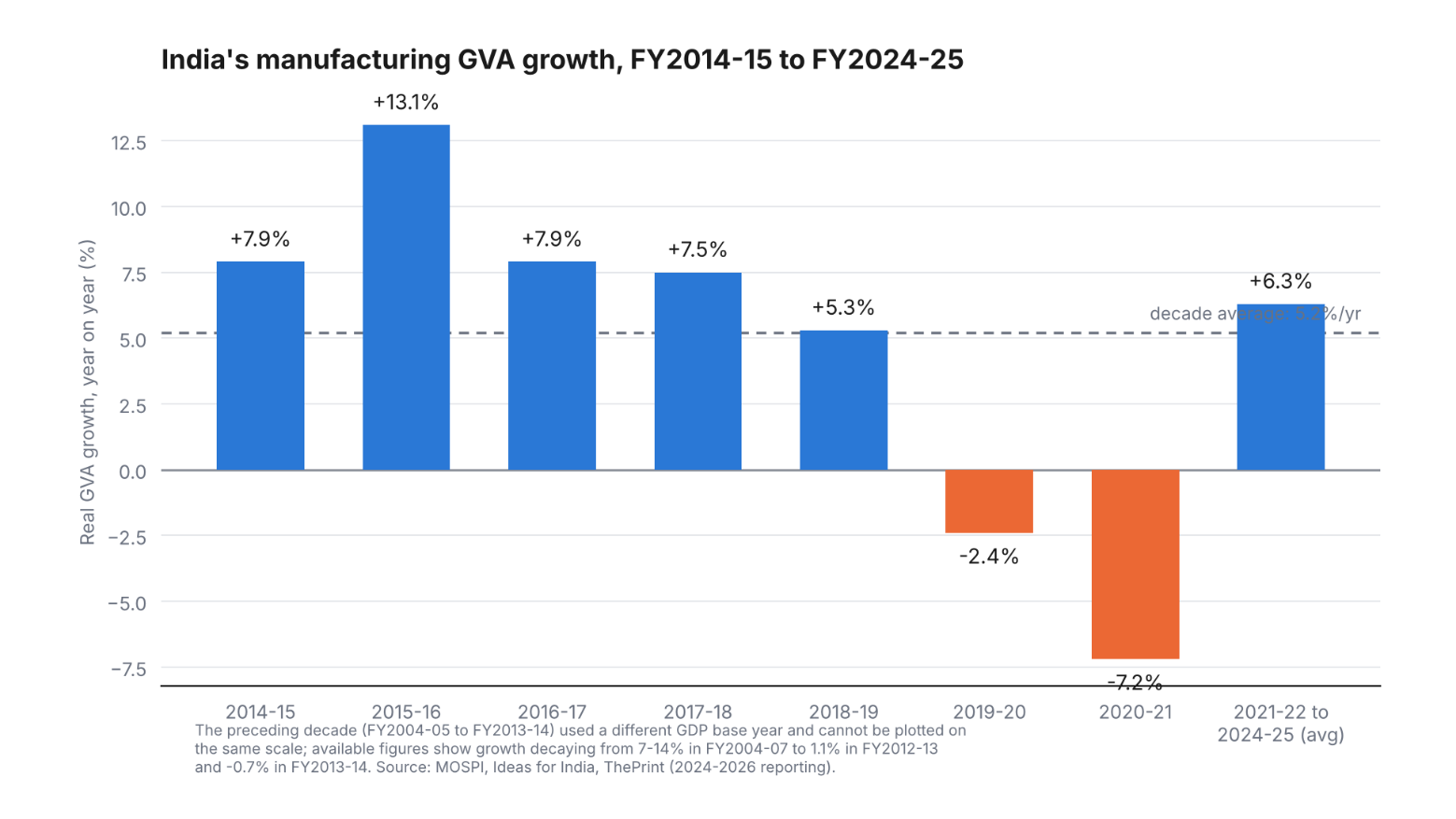
The rupee's fall is a headline often cited against India, but the Reserve Bank of India's governor believes it to be less of a challenge than opinion pieces make it out to be. Sanjay Malhotra, speaking as the rupee neared a record low of 96.84 to the dollar in October 2026, said that "by a number of estimates, including the real effective exchange rate, the rupee is not overvalued; it may be undervalued," adding that "financial markets can be irrational in the short run. It is only in the long run they are able to find the right value." A currency trading below the value its central bank assigns it is not the same signal as a currency in real decline. It must also be remembered that the renminbi remains artificially deflated and the same question is not often raised about China. Yes, it is due to its manufacturing capacity, and yes, India's does not come close. However, India's manufacturing sector has grown at an average of 5.2% a year in real terms over the decade from FY2014-15 to FY2024-25. Indian manufacturing (5.2%) outgrew the EU (2.0%), the US (1.5%), and Brazil, which actually contracted (-1.2%) over the same decade. It has not contributed as significantly to GDP, but that is due to services growing faster at the same time, which says nothing about the pace of manufacturing growth itself.
Defence manufacturing, for one, has converted a currency gap and a decade of procurement policy into measurable stock performance. The eighteen constituents of the Nifty India Defence index added ₹1,46,807 crore in combined market capitalisation across 2025, rising from ₹9,28,043 crore to ₹10,74,851 crore. Bharat Electronics rose 34% over the year, adding ₹73,354 crore, Solar Industries added ₹22,893 crore and Hindustan Aeronautics added ₹13,409 crore. The Defence Acquisition Council approved roughly ₹3.3 lakh crore in procurement over the same stretch, against a defence budget of ₹6.8 lakh crore that included ₹1.8 lakh crore earmarked for capital acquisition. The figures depict a procurement pipeline that has been running for years and speak to the importance of relative political stability and capex growth that have set the Indian economy apart from the rest of the world.
Shipbuilding has followed a similar pattern, but the numbers start from a much smaller base. Cochin Shipyard won an order worth more than ₹2,000 crore from the French shipper CMA CGM in October 2025 for six LNG-powered container vessels, its first major international commercial win of that scale. Mazagon Dock Shipbuilders carried an order book of roughly ₹27,400 crore as of the end of September 2025, and the company has said it is targeting an order book above ₹1 lakh crore by the end of the current financial year, helped by a six-submarine deal under the P-75I programme still under negotiation. The government has separately cleared a ₹44,700 crore shipbuilding scheme benefiting Mazagon Dock, Garden Reach and Cochin Shipyard directly.
The pharmaceuticals sector has supplied an important sort of resilience built on exports rather than domestic procurement, which is less common in much of the Indian market. India's pharmaceutical exports crossed $30 billion in the 2025 financial year, rising more than 9% from the previous year's $27.85 billion, with exports to the United States alone reaching $8.95 billion, up 14.3% year on year. The Nifty Pharma index hit a record high in July 2026, having risen 17% over the preceding six months, with Divi's Laboratories, Torrent Pharma and Sun Pharma all setting fresh highs in the same session. Analysts covering that rally pointed to strong earnings visibility and a shift within Indian pharma from basic generics toward higher-value specialty drugs, and to the sector's role as a destination for capital during a period of broader market volatility.
Average annual manufacturing growth, FY2014-15 to FY2024-25 — Real terms — India: 5.2%; EU: 2.0%; US: 1.5%; Brazil: -1.2% — Brazil's manufacturing contracted over the decade, so its bar is shown at zero with its value labelled.
Over the past two years, Brazil's mining and energy sectors have spent two years exposed to China and learning how much of the world's steel and commodity demand China can actually sustain. Vale, the mining group most dependent on Chinese steel demand, fell roughly 20% in the first five months of 2024 as China's economy weakened, dragging the Ibovespa down 15.3% in dollar terms over the same stretch, the worst performance of any G20 market in that period. Petrobras added more domestic pressure that year, as investors priced in fears of state intervention in the company's leadership, while delayed US interest rate cuts pulled capital away from emerging markets generally. The index surged to an all-time high of 206,912 points on 5th October 2026, up 74% from its 2024 low, in a single-day 7.7% jump following the first round of Brazil's 2026 election. It then corrected sharply, falling to around 168,498 by 6th November 2026, an 18.5% pullback from that peak in about a month, but still roughly 42% above the 2024 low, showcasing how overdependence in strategic sectors affects economic equanimity.
The $3.5 trillion wiped from Chinese equity values since May 2026 followed a reported September 2025 directive from Beijing instructing major technology firms to stop purchasing Nvidia chips, compounding separate pressure from US chip restrictions, elevated US interest rates and weak Chinese consumer spending. The squeeze, a small preview of a bursting bubble forced to remain inflated through a sunk-cost fallacy, has been significant and, despite recovery over the following days, showcases the volatility. In a globalised world, overdependence on international markets has strategically consequential results.
The United States has avoided a Brazil- or China-style collapse, but it ran into a sharp reversal in the first week of November 2026. The S&P 500 rose 1.6% on 4th November as markets reacted to the midterm election results, then fell the following day in a broad artificial-intelligence sell-off that erased an estimated $1.45 trillion in value across twelve of the most closely tracked AI stocks in a single session, with Nvidia down 9.26% to its lowest close since January 2025 and the Nasdaq Composite falling 5.52%. With Jensen Huang's sex-life misdemeanours revealed, the fall is expected to continue, even as Taiwan corrects itself. The CBOE Volatility Index rose 69.7% that same day, from 16.61 to 28.18. Both indices partially recovered on 6th November, the S&P 500 up 0.3% and the Nasdaq up 1.1%, leaving them up 7.8% and 5.8% respectively for the year. That single-day rout followed a month in which AI and semiconductor stocks had already shed an estimated $5 trillion in combined market capitalisation since 6th October.
An inflation problem adds to the pressure on US valuations. Consumer prices rose 3.7% year on year in September 2026, with a core rate of 2.6%, both still running above the Federal Reserve's 2% target. India's inflation moved in the same direction over the same window, with retail inflation rising to 4.38% in June 2026 from 3.93% in May, the first breach of the Reserve Bank's 4% target under its current measurement series, driven by a 5.32% rise in food prices. The Reserve Bank raised its inflation forecast for the 2026-27 financial year to 5.1% from 4.6% in response, citing the same global energy costs pressuring prices everywhere else.
What distinguishes India's inflation and currency pressure from the version playing out in the United States is the growth rate sitting underneath both. India's real GDP growth has not fallen below 7% in any of the past four fiscal years, a run that includes the 9.7% rebound from the pandemic-year contraction in FY2021 and a steady 7.1% to 7.6% range since. The IMF's October 2026 World Economic Outlook projects India at 7% growth for both 2026 and 2027, roughly double the rate it forecasts for the United States or China over the same period. A currency pressured by imported energy costs and a stock market absorbing eleven months of foreign selling are both compatible with that growth rate continuing.
India's demographic position is built to sustain that growth rate for longer than its two largest Asian rivals can sustain theirs. The median age in India is approximately 28, against 38 in China and 48 in Japan, and roughly 65% of the population is under 35. The working-age share of the population, 66% as of 2023, is projected to keep expanding, with the workforce approaching one billion people by 2047. China and Japan are both ageing while India's labour supply is still growing, a divergence that changes the kind of growth each economy can realistically sustain into the 2040s regardless of where their currencies or equity indices sit in any given month.
Credit markets have reached a broadly similar conclusion regarding India's economy. Japan Credit Rating Agency upgraded India's foreign-currency rating to A-minus with a stable outlook in 2026, following S&P's August 2025 upgrade to BBB, India's first sovereign upgrade in eighteen years. The agencies made the call while the rupee was sliding toward the record low the Reserve Bank governor later described as undervalued rather than weak, and while foreign institutional investors were in the middle of an outflow streak that had already run past ten consecutive months.
The past two years have clearly showcased a distinction between markets whose declines trace to structural problems inside their own economies and markets whose volatility traces to shorter-term external costs. Brazil's 2024 slide followed fiscal and governance concerns inside Brazil, while China's 2026 correction shows sectoral overdependence upon a technology sector whose earnings could not support the valuations built on top of it, compounded by its own government's restrictions on the chips the sector actually needed. India's pressure is external, geopolitical, and not structural. Investors have the options and it is up to their analysis to decide whether to park their money in resilient economies over more volatile ones.
If this piece was useful, subscribe for the right take on global affairs and expert opinions. It is free.
Read more on India
The End of the Cartel Century: OPEC, Russian Crude, US Shale and India's Refining Pivot
A Research White Paper on the Geopolitics of the Global Oil Transition
08 Nov 2026A diya in every embassy: How India uses Diwali to bring home to its diaspora
From the first indentured ship to reach Mauritius to a floating holiday at the UN, Diwali has travelled with India's diaspora. Today, India's missions abroad are helping turn it into a bridge between that diaspora, the countries it lives in, and home
02 Oct 2026The Gandhian Logic of Peace: India Builds a Larger Playground at BRICS
From Gandhi's internationalism to non-alignment and now multi-alignment, India's 2026 BRICS chairship shows how a large country keeps its freedom of choice.
More from Trade & Finance
The Hindu Rate of Growth, Reclaimed: India's Case for a New Economic Identity
A Whitepaper on Policy, Growth, and India's Rise in the Global Economic Order, 2014–2026
09 Oct 2026India's Labour Data Has No Category for Gig Workers
Gig workers are now covered by the Code on Social Security, yet the PLFS, e-Shram and Census 2027 do not identify platform work. Four changes would fix that.
24 Sept 2026The Fading Force of American Tariffs on China
Weeks after China tightened rare-earth licensing in 2025, a Ford plant stopped. Xi Jinping arrives in Washington with the same licensing rules still in force.