Too Many Arabian Proxy Wars; Too Little Peace
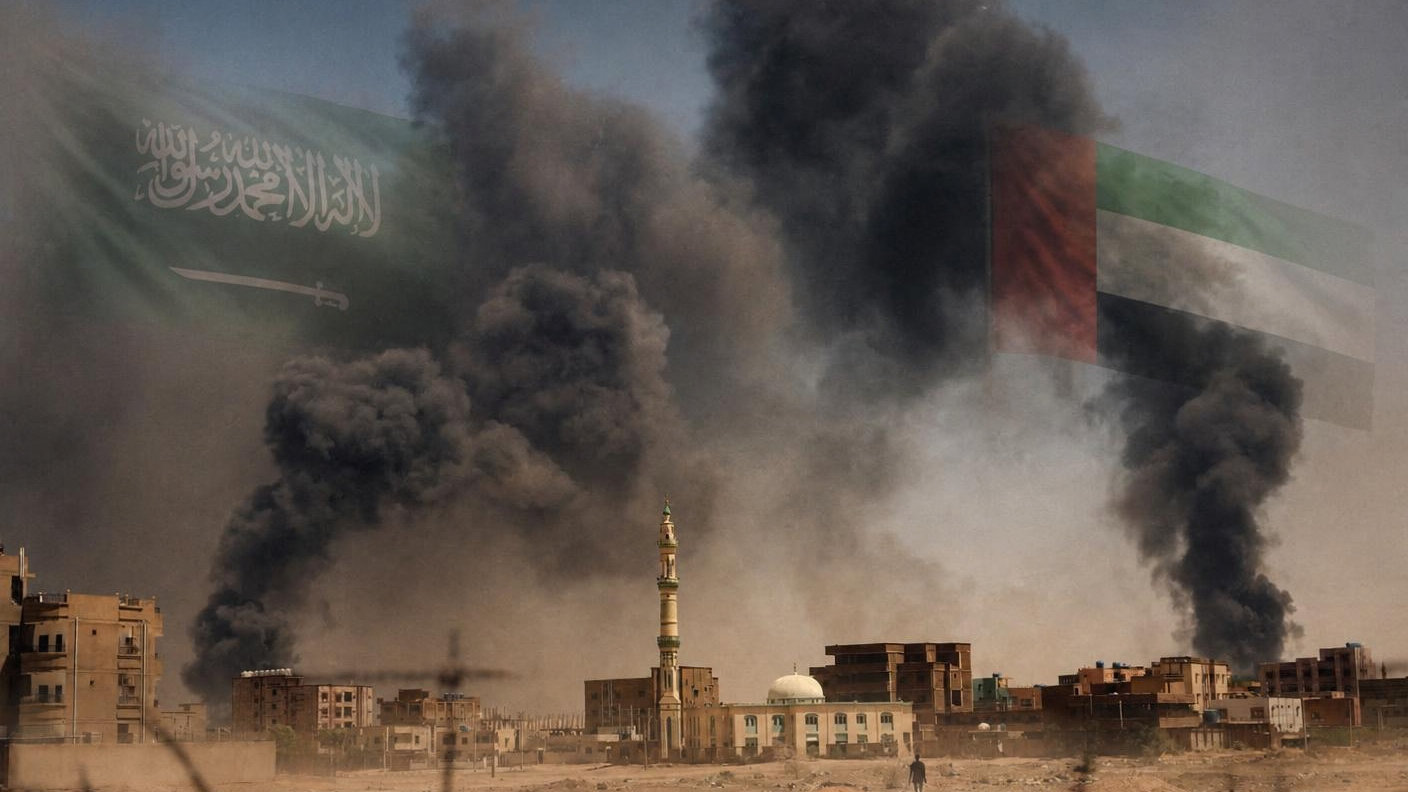
Partners in Yemen's 2015 coalition, Saudi Arabia and the UAE now arm opposing sides in Sudan's civil war and southern Yemen, while Sudan's civilians bear the world's largest displacement crisis.
Sudan's civil war has displaced 14 million people since fighting began on 15th April 2023, with 9 million uprooted inside the country and 4.4 million crossing into Chad, South Sudan and Egypt. The UN recorded 11,300 civilian deaths in 2025 alone, and verified more than 200 attacks on health facilities, which killed 2,052 people. Analysis from the Center for Strategic and International Studies (CSIS)and the International Crisis Group corroborates the scale of displacement and describes the crisis as the world's largest. Some 21 million Sudanese face acute food insecurity, of whom 6.3 million sit in the most severe emergency category, according to UN News reporting from April 2026.
Sudan is currently the most burnished icon of a pattern -- Saudi Arabia and the UAE, historically aligned as Gulf partners and joint backers of the 2015 Yemen intervention, ending up financing opposing sides of conflicts. The current war sees the Sudanese Armed Forces (SAF), led by General Abdel Fattah al-Burhan, against the Rapid Support Forces (RSF), commanded by Mohamed Hamdan Dagalo, known as Hemedti. The two men had jointly led Sudan's transitional government after the 2019 fall of Omar al-Bashir and jointly backed the 2021 coup that removed civilian leadership, before turning on each other in April 2023. Both forces have committed documented abuses against civilians. The RSF's siege of El Fasher, the last major SAF stronghold in Darfur, became the war's defining atrocity through 2025 and into 2026, with Amnesty International and UN investigators documenting mass killings and ethnic targeting in the city that the UN described in February 2026 as bearing "hallmarks of genocide." The SAF has been implicated in its own attacks on civilians, including a December 2024 airstrike on a crowded market in RSF-held Kabkabiya, North Darfur, that Amnesty said killed dozens and called a flagrant war crime. A UN report published earlier this month found SAF forces had used foreign-supplied drones in attacks on civilian areas, alongside separate incidents in which rights groups have documented SAF drone and air strikes on markets and hospitals in North Darfur.
Of the two Gulf states, the UAE's alignment in Sudan runs toward the RSF. A UN Panel of Experts report and Amnesty International's May 2026 findings both describe evidence of arms reaching the RSF via Chad, including Chinese-manufactured weapons systems that Amnesty traces to the United Arab Emirates. The UAE has repeatedly and consistently denied arming the RSF, saying in a June 2024 statement to the UN Security Council that it has supplied no arms or related material to any party in Sudan, and it pledged $15 million to UNHCR's Sudan response in December 2025. Sudan's government severed diplomatic relations with Abu Dhabi in 2025 over the allegations and brought a case at the International Court of Justice accusing the UAE of complicity in genocide.
Chatham House research describes gold as the connector for Sudan's war with a wider regional conflict economy. Large volumes of Sudanese gold, much of it mined in RSF-held territory, reach Dubai's refining and trading markets. Sudan also carries broader strategic weight since its Red Sea coastline runs for roughly 750 kilometres, positioning any external power with influence there close to shipping lanes that feed the Suez Canal. Its agricultural land and Nile access have long drawn Gulf state investment in food security. For a country with so much potential, lacking nothing in terms of natural resources or geography, Sudan remains in the unfortunate embrace of native strongmen aligning with foreign powers to terrorise its own citizens for power.
Sudan: People Displaced and Facing Hunger — Millions of people — Acute food insecurity: 21m; Displaced in total: 14m; Displaced inside Sudan: 9m; Emergency food insecurity: 6.3m; Crossed borders: 4.4m — Displacement since fighting began on 15 April 2023; 4.4m crossed into Chad, South Sudan and Egypt. Food insecurity figures from UN News, April 2026; the emergency category is the most severe level.
Riyadh, on the other hand, has provided al-Burhan's SAF with financial and political backing beyond hosting the 2023 Jeddah talks that produced no lasting ceasefire. Al-Monitor reported that Crown Prince Mohammed bin Salman hosted al-Burhan in Jeddah on 20th April 2026 and that Saudi Arabia had underwritten a Pakistan-brokered arms package for Sudan's army worth $1.5 billion, a deal the report said Riyadh subsequently moved to suspend. Saudi Arabia has publicly distanced itself from directly supplying weapons, while continuing financial and diplomatic support for al-Burhan's government through the Quad grouping alongside the United States, the UAE and Egypt.
In Libya, the UAE has armed and funded Khalifa Haftar's Libyan National Army in the country's east since at least 2019, including reported use of Chinese-made Wing Loong drones documented by UN investigators. Saudi Arabia's role has centred on financing rather than weapons supply: Al Jazeera reported in April 2019, citing documents seen by the New York Times, that Saudi Arabia pledged Haftar substantial financial backing shortly before his offensive on Tripoli that year, and researchers including Insight Turkey have traced Saudi funding to Madkhali Salafist militias operating alongside Haftar's forces. The country remains split between the UN-recognised Government of National Unity in Tripoli and eastern authorities backed by Haftar, with a 2020 ceasefire witnessing regular violations and reunification talks stalled through 2026, according to Security Council Report monitoring. Libya's importance to outside powers rests on its position as Africa's largest proven oil reserve holder and its Mediterranean coastline, a route for migration flows into Europe that has made control of its ports a bargaining chip well beyond Libya's own borders.
Deaths Reported in Sudan and Yemen — Figures cited by the UN — Yemen, to end-2021: 377,000; Sudan, civilians in 2025: 11,300; Sudan, health-facility attacks: 2,052 — Yemen: UNDP projection to the end of 2021, counting direct combat deaths and indirect deaths from blockade, disease and famine. Sudan: UN figures for civilian deaths in 2025 and deaths in more than 200 verified attacks on health facilities.
Yemen represents the longest-running instance of Saudi-Emirati divergence, and the one where the two governments started out as formal allies before splitting from within the same coalition. Saudi Arabia has led the coalition backing Yemen's internationally recognised government against the Houthi movement since 2015. The UN Development Programme projected in a November 2021 report that the war would leave 377,000 people dead by the end of that year, counting both direct combat deaths and indirect deaths from the coalition's blockade, disease and famine. Coalition airstrikes documented by Médecins Sans Frontières and Amnesty International include the August 2018 strike on a school bus in Dahyan that killed dozens of children, in which Amnesty identified a US-made bomb, and repeated strikes on MSF-supported hospitals that the organisation has said were carried out despite coordinates being shared in advance with the coalition. A UN Group of Eminent International and Regional Experts on Yemen concluded in a September 2020 report that all parties to the conflict, including the Saudi-led coalition and the Houthi movement, may bear responsibility for war crimes, describing a conflict with "no clean hands" and calling for a UNSC referral to the ICC. Saudi Arabia has disputed individual incident findings and attributed some civilian casualties to Houthi use of populated areas for military purposes. Separate from the coalition's record, the UAE built up and funded the Southern Transitional Council (STC), which seeks southern secession and has repeatedly fought forces nominally on the same side of the war. Analysts describe the resulting Saudi-UAE dynamic as a cold war playing out inside the wider coalition. Yemen's relevance to both Gulf states runs through the Bab el-Mandeb Strait, which the Houthis seized full control of along Yemen's Red Sea coast in September 2026, giving the group command over a passage that roughly 10% of global seaborne trade transits in ordinary years. Control of the strait, and of Yemen's southern ports including Aden, bears directly on Gulf state access to Red Sea and Indian Ocean shipping routes that feed their own economies.
Unsurprisingly, the winners of these wars reside outside the borders where they are fought, pulling the strings from afar. Beyond Saudi Arabia and the UAE, too many other nations are invested in what has become a near-endless run of proxy wars. China is a documented arms source to multiple factions across the three conflicts to all sides: Chinese-manufactured weapons, including FH-95 drones and GB-25A guided munitions, have reached both the RSF and the SAF in Sudan, and well reported in 2026 is the fact that Haftar's forces in Libya acquired Chinese combat drones despite the UN arms embargo, while the Houthis in Yemen have separately imported Chinese drone components. The United States remains the single largest original source of the weapons in circulation across these conflicts, having sold tens of billions of dollars in arms to Saudi Arabia and the UAE over the past decade according to Congressional Research Service figures, with Amnesty identifying US-made munitions in confirmed coalition strike on Yemeni civilians, such as the 2018 Dahyan school bus attack.
Conflict resolution efforts across all three fronts have so far produced unstable ceasefires rather than significant settlements. In Sudan, the Jeddah Framework and subsequent African Union and IGAD-led mediation attempts have failed to secure a durable truce, with UNHCR representative Marie-Helene Verney telling reporters in April 2026 that there was no clear progress toward resolution. Proposed paths forward include a verified arms embargo enforced against any state found supplying either the RSF or the SAF, an internationally monitored humanitarian corridor into besieged Darfur cities, and a mediation track that treats outside states with documented material involvement, rather than only Sudan's own factions, as parties to the negotiation. In Libya, UN-backed unification of the country's rival administrations and a verified withdrawal of foreign forces, a demand repeated in successive Security Council resolutions since 2020, remain the stated benchmarks for ending the stalemate. In Yemen, UN Special Envoy-led talks have periodically produced partial truces, most durably in 2022, though the Houthi seizure of Bab el-Mandeb in September 2026 has reopened questions about permanent stability.
The countries in a state of war lack the wherewithal to withdraw from the bloody scenario they have been drawn into. The UNSC remains, frankly, toothless. The Arab monarchies fighting proxy wars using Chinese and American-made weaponry are set to remain clear winners until one doesn’t. Cries for Sudan’s humanitarian crisis are finally being heard in the American mainstream; however, hope for peace remains fragile.
More from War
Borrowed Soldiers: The Mecca Pact’s First Test
As Houthi missiles reach Riyadh, Saudi Arabia has sent out an SOS to its oldest patron and its newest allies. Their answers, or rather “Statements” of solidarity show how much protection was ever on offer.
19 Sept 2026Kyiv's International Footprint as Viewed from the Receiving End
Budanov marks Intelligence Day by describing Ukrainian reach that runs from Germany to Africa. Foreign governments register UN cases against HUR's overreach.
07 Sept 2026From Seoul to the Sauds to the Strait of Hormuz: A Single War With No Exit in Sight
Drone, interceptor and oil shortages are shaping the realities of theatre convergence from Seoul to Taipei, even as a fragile backchannel opens toward peace.