Borrowed Soldiers: The Mecca Pact’s First Test
As Houthi missiles reach Riyadh, Saudi Arabia has sent out an SOS to its oldest patron and its newest allies. Their answers, or rather “Statements” of solidarity show how much protection was ever on offer.
In The Prince, written in 1513, Niccolò Machiavelli warned rulers against relying on auxiliaries, the forces of another power called in to defend them. “The arms of others,” he wrote, “either fall from your back, or they weigh you down, or they bind you fast.” Five centuries later, Saudi Arabia is testing that warning. Its oldest patron has so far declined to fight, and its new treaty allies have answered its call on their own terms.
The Cost to Riyadh
Since October 6, Houthi strikes on King Khalid International Airport in Riyadh and Abha International Airport have intensified and killed at least 20 people, according to an Associated Press tally. The deadliest attack since the strikes happened, on October 10, leading to 13 deaths and leaving more than 300 injured. The dead included Saudi citizens and nationals of at least nine other countries, among them the United States, Pakistan and India. Riyadh’s airport has been shut until at least 17 October, and close to 400 flights were cancelled on the day of the attack alone.
The strikes then widened. On October 13, the Saudi Energy Ministry reported a limited fire at an Aramco administrative building in Dhahran, and shrapnel from interceptions damaged over 10 homes in Riyadh. On 15 October, air defences destroyed a cruise missile over Madinah. If reports from The Wall Street Journal are to be believed, the kingdom is running low on interceptor missiles and is moving batteries to protect energy sites and palaces.
Washington Maintains Distance
Before invoking its new pact, Riyadh turned to its old ally Washington. Around September 11, Crown Prince Mohammed bin Salman called President Donald Trump twice in one day to urge US strikes on the Houthis, according to Axios. Trump declined, offering intelligence and targeting data. After a second Saudi request, he held off again. Days later, US diplomats met Houthi officials and received assurances that the group did not intend to close the Bab al-Mandeb strait to shipping.
After the Riyadh airport attack, in which an American was among the dead, Trump said: “We may. We’re going to look at it.” By 13 October he had not decided, but said of the Turkish president: “President Erdogan, I think, would do as I ask.” The same day, the State Department barred its staff from using Saudi airports without special authorisation. Saudi Arabia, a long-standing buyer of American Patriot systems, is finding that its purchases do not come with a commitment to fight, or even an assured support from an ally at a time of crisis like the current.
The Pact’s First Call
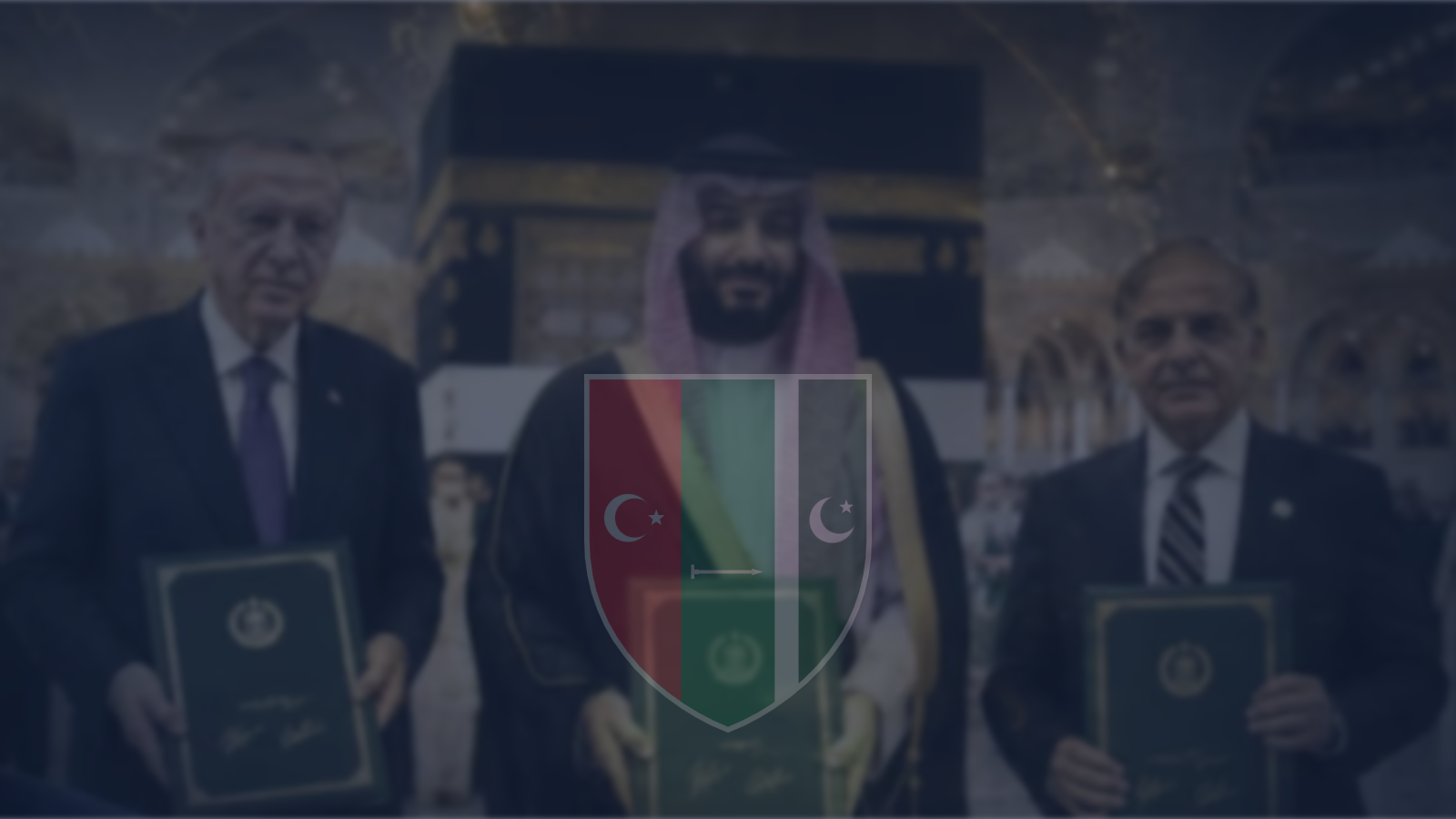
On 5 October, Saudi Arabia, Pakistan and Türkiye agreed in Riyadh to “provide the agreed military forces and capabilities and ensure their rapid deployment” to the kingdom. It was the first invocation of the Mecca Joint Defence Agreement, signed on 7 August, under which an attack on one is treated as an attack on all. Until then, the alliance had taken no action through a month of Houthi strikes; analysts told Al Jazeera that Pakistan and Türkiye were reluctant to give up their roles as mediators in the US-Israel war on Iran.
What followed was modest. Pakistan’s military spokesman said on 8 October that Pakistani forces were “already there”, adding that they “have been there for decades”. Earlier in May this year, Reuters had reported some 8,000 Pakistani troops, a squadron of fighter jets and an air defence system being deployed in Saudi under the 2025 bilateral pact. From a larger view point, officials from both Pakistan and Türkiye have described their role as supportive rather than combat.
Stand on Conditionality by Design
Ankara has set the clearest limits. In a statement from October 9, the Turkish Foreign Minister Hakan Fidan stated how the pact does not authorise Türkiye to send troops into another country’s territory to carry out an attack. Interestingly, the Turkish parliament is also yet to ratify the agreement and a separate parliamentary mandate is needed to deploy forces abroad.
An earlier incident from 2015 should also be brought into picture when Saudi Arabia had asked Pakistan to deploy its warships, aircrafts and troops for Riyadh’s campaign in Yemen, Pakistan’s parliament had unanimously voted to stay neutral. Considering the widely different political situation in Islamabad a decade later, in an interesting turn of events, the commitment to deploy troops and extend support to Saudi under Mecca pact went ahead without a parliamentary vote.
What Islamabad Gains
For Pakistan, the arrangement costs little internally and pays in standing. Riyadh, on multiple occasions, has supported Islamabad financially during periods of economic stress. On October 7, two days after the Riyadh meeting, the International Monetary Fund reached a staff-level agreement to release about $1.2 billion to Pakistan, subject to Executive Board approval. The review belongs to a programme agreed in 2024, but the IMF credited Islamabad with having “successfully navigated the impact of the Middle East conflict”. Pakistan now presents itself as a security provider to the Gulf’s largest economy while its forces remain in roles it has held for decades.
What to Watch
With time, the observers should watch for three things to see if this pact is just a mere declaration or more: Turkish ratification and any deployment mandate, Pakistani forces moving beyond support roles, and if America decides to take a role beyond just an arms supplier in the conflict.
The kingdom’s own history explains the pattern. In 1990, when American interests were at stake after Iraq invaded Kuwait, US forces arrived in the hundreds of thousands. In 2015, when Riyadh asked Pakistan for warships, aircraft and troops for Yemen, Pakistan’s parliament voted unanimously to stay neutral. Help came when it served the helper. Today, Washington’s support has come down to the role of being an intelligence provider and issuer of statements, Ankara’s comes weighed down with conditions, and Islamabad’s binds the kingdom more closely to a partner it has repeatedly financed. All three of Machiavelli’s outcomes are now visible.
Thucydides wrote his History of the Peloponnesian War for readers “who desire an exact knowledge of the past as an aid to the interpretation of the future”. The record here is long enough to read. A treaty does not change a partner’s interests, and Riyadh’s partners have shown theirs before. A state that relies on borrowed soldiers, without building its own defences or ending the war that requires them, risks learning the same lesson again.
Misha Bhatt is a communications professional and educator who led India's delegation to the BRICS Youth Summit 2026 in Gandhinagar under the Ministry of Youth Affairs and Sports, and earlier served as a G20 Y20 Research Associate during India's presidency. She is a visiting professor at HSNC University and KES Shroff College in Mumbai.
The views expressed in this piece are the author's own. Global Outlook publishes contributed opinion as a platform and does not endorse it.
More from War
Too Many Arabian Proxy Wars; Too Little Peace
Partners in Yemen's 2015 coalition, Saudi Arabia and the UAE now arm opposing sides in Sudan's civil war and southern Yemen, while Sudan's civilians bear the world's largest displacement crisis.
19 Sept 2026Kyiv's International Footprint as Viewed from the Receiving End
Budanov marks Intelligence Day by describing Ukrainian reach that runs from Germany to Africa. Foreign governments register UN cases against HUR's overreach.
07 Sept 2026From Seoul to the Sauds to the Strait of Hormuz: A Single War With No Exit in Sight
Drone, interceptor and oil shortages are shaping the realities of theatre convergence from Seoul to Taipei, even as a fragile backchannel opens toward peace.